How to Rig for Surf Fishing in New Jersey
There’s nothing quite as frustrating as heading to the New Jersey shore, setting up your gear, only to lose your bait to the waves, get snagged repeatedly, or worse – spend hours casting without a single bite. It can feel like an impossible puzzle, especially when you see experienced anglers pulling in fish right next to you. This comprehensive guide will unravel the mysteries of surf fishing rigs, walking you through the essential components, popular setups, and crucial techniques to help you effectively target various species right from the beach.
Understanding the Surf Zone and Its Unique Challenges
Surf fishing in New Jersey is a truly unique experience, but it comes with its own set of hurdles that you just don't face in a quiet lake or even a calm bay. The dynamic nature of the ocean makes proper rigging absolutely critical. Without the right setup, you’re often just feeding the crabs or donating your tackle to the sea.
The Dynamic Environment of the New Jersey Shore
Think about it: you're casting into a constantly moving, powerful body of water. The waves are pushing and pulling, currents are running parallel to the shore, and the bottom is rarely flat or consistent. One day you might have a gentle roll, the next it’s a churning washing machine. This relentless motion is what makes fishing the surf so challenging and, frankly, why many beginners get discouraged. Your bait needs to stay put enough to be noticed by a fish, but also move naturally to entice a strike. It’s a delicate balance. Plus, you’re dealing with sand, shell fragments, and sometimes rocks, all conspiring to snag your line. This is also why understanding How to Read a Rip Current for Safer Surf Fishing is so important, not just for safety, but for understanding how fish move.
Common Rigging Pitfalls for New Jersey Surf Anglers
Many newcomers to surf fishing make a few common mistakes that lead to frustration. One of the biggest is using tackle that’s too light or too heavy for the conditions. Too light, and your bait gets washed right back to shore; too heavy, and it sinks into the sand and gets buried. Another frequent error is using leader material that's either too visible or not abrasion-resistant enough. The ocean is full of toothy critters and sharp debris, and a flimsy leader is a recipe for heartbreak. Not understanding how your sinker interacts with the bottom is another big one. A pyramid sinker might hold well in a strong current, but it can also dig itself in and become impossible to retrieve. These are the kinds of issues that can quickly turn a hopeful fishing trip into a lesson in losing gear.
Essential Components of Any Effective Surf Fishing Rig
Before we dive into specific rigs, let's talk about the foundational elements you'll need. Think of these as your building blocks. Getting these right is half the battle, and it's where many anglers can upgrade their setup significantly.
Rods, Reels, and Line for the Jersey Shore
Your rod and reel are your primary tools for battling the surf. For most New Jersey surf fishing, you're going to want a longer rod, typically between 9 and 12 feet. This length gives you the leverage to cast heavier baits and sinkers out beyond the breaking waves and allows you to keep your line above the incoming surf, reducing drag. Look for rods with a medium-heavy to heavy power and a moderate-fast action. A good example is a medium-heavy Ugly Stik GX2 or a comparable Tsunami Airwave Elite, both readily available on platforms like Amazon.
When it comes to reels, you need something robust and sealed to withstand the saltwater environment. A spinning reel in the 6000 to 8000 size range is usually ideal. Brands like Penn Battle, Shimano Spheros, or Daiwa BG are popular choices that offer durability and smooth drag systems. Spool your reel with braided line, as it offers superior casting distance and sensitivity compared to monofilament. For most applications, a 30 to 50 lb test braided line is sufficient. You might be wondering What Pound Test Line for Surf Fishing, and while personal preference plays a role, this range strikes a good balance for fighting powerful fish and handling heavy weights. Don't forget a top shot of monofilament or fluorocarbon leader, which we'll discuss next.
Sinkers, Leaders, and Hooks: The Business End
This is where your rig truly takes shape. The right sinker is paramount. Pyramid sinkers are common for holding bottom in strong currents. Sputnik sinkers, with their wire legs, are excellent for really digging in and preventing your bait from moving. Disappearing sinkers, or "bank" sinkers, are better for lighter current or when you want your bait to roll a bit. The weight of your sinker will depend entirely on the conditions – anything from 2 to 8 ounces is common.
Your leader material needs to be tough. Fluorocarbon is often preferred because it's nearly invisible underwater and highly abrasion-resistant. A 30-50 lb test fluorocarbon leader is a good starting point, though some anglers go heavier for toothy fish like bluefish or larger striped bass. The length can vary from 18 inches to several feet, depending on the rig. As for hooks, the size and style depend on your target species and bait. Circle hooks are often mandated or highly recommended for many species, especially if you're fishing bait for striped bass, as they greatly increase the chances of a lip hook and safer release. Octopus or Kahle hooks are also popular for various baits.
Popular New Jersey Surf Fishing Rigs and When to Use Them
Now that we have the individual components, let's put them together into effective surf fishing rigs. Each rig has its strengths and weaknesses, making it better suited for certain conditions or target species.
The Classic Fish-Finder Rig
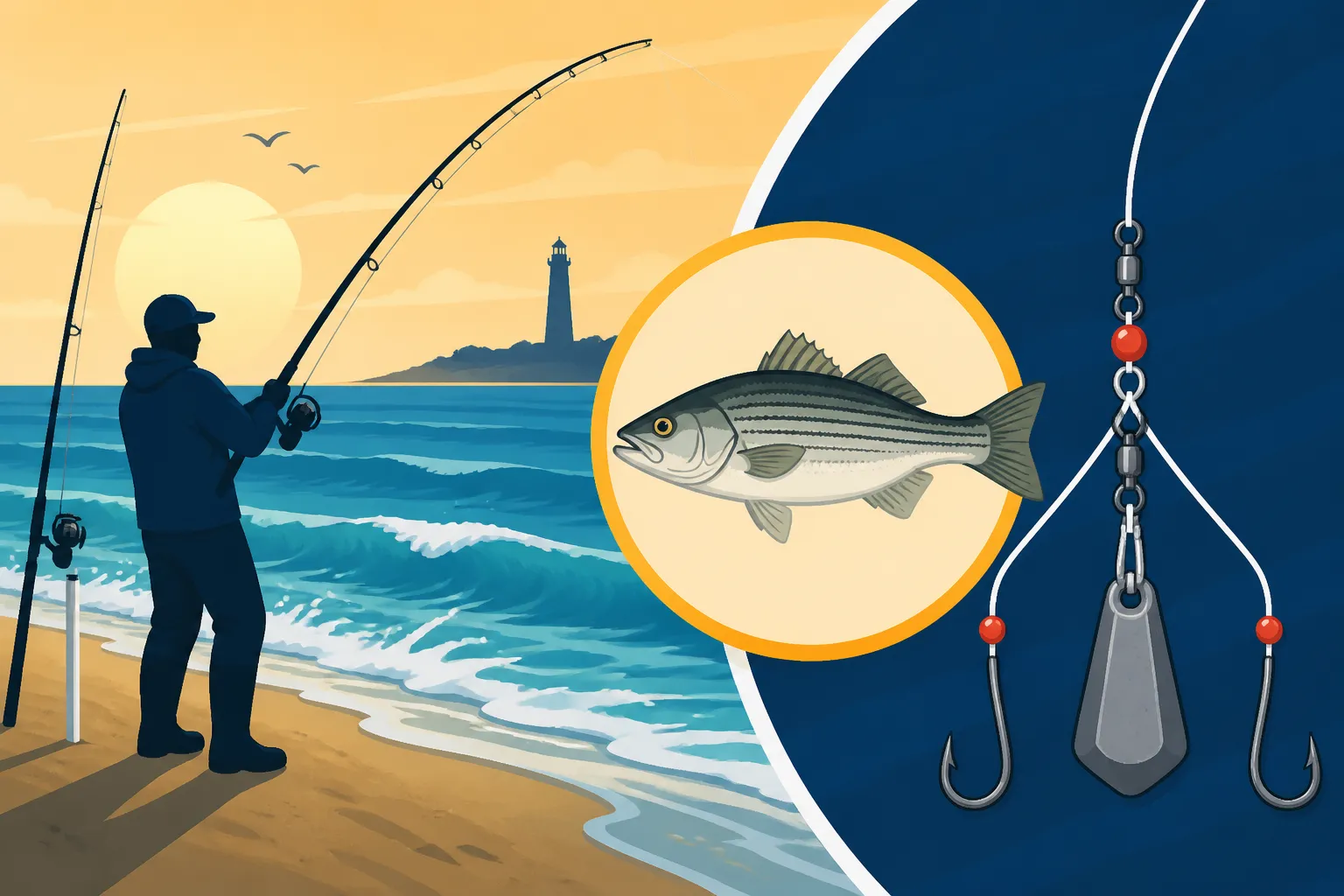
The fish-finder rig, sometimes called a slider rig, is arguably the most popular and versatile rig for surf fishing in New Jersey. It's incredibly simple and effective. The beauty of this rig is that it allows the fish to take the bait and swim off without feeling the weight of the sinker immediately. This translates to more confident bites and better hookups.
How to Tie It: Start by threading a fish-finder slide (which has a snap swivel attached) onto your main line. Tie a heavy barrel swivel to the end of your main line. To the other end of the barrel swivel, tie a leader of fluorocarbon or monofilament, typically 18 to 36 inches long. Finally, tie your hook to the end of the leader. You’ll attach your sinker to the snap swivel on the fish-finder slide. This setup allows the sinker to rest on the bottom, while your main line can slide freely through the clip, letting the fish run with the bait. This is an excellent rig when you are surf fishing for Striped Bass Fishing in New Jersey with bait like clams or bunker.
When to Use It: This rig excels when you're targeting bottom feeders or species that tend to mouth the bait before committing, like striped bass, red drum (though less common in NJ surf, they're here!), or even larger fluke. It's fantastic for fishing with natural baits such as clam bellies, bunker chunks, or whole mullet. It's especially effective in moderate currents where you want your bait to stay in one general area without getting completely buried. It minimizes the drag felt by the fish, which is crucial for finicky eaters.
The Versatile High-Low Rig
The high-low rig, also known as a top-and-bottom rig or a "fluke rig" in some circles, is designed to present multiple baits at different depths in the water column. This increases your chances of finding where the fish are feeding and allows you to target a wider variety of species simultaneously.
How to Tie It: This rig typically involves tying two dropper loops or snelling two leader sections directly onto a longer section of leader material. Start with a 3-5 foot length of heavier leader (e.g., 40-50 lb test fluorocarbon). About 12-18 inches from one end, tie a dropper loop or snell a short 6-inch leader with a hook. Repeat this process another 12-18 inches up the main leader. At the very bottom, tie on a snap swivel for your sinker. At the very top, tie another heavy barrel swivel to connect to your main line. You'll attach your hooks to the loops or leaders. This means you have two baits suspended off the main leader, one higher and one lower.
When to Use It: The high-low rig is a phenomenal choice when you're targeting species that might be feeding at varying depths or when you're unsure where the fish are holding. It's perfect for panfish like kingfish, croakers, or even smaller bluefish and fluke. If you're specifically targeting Fluke and Summer Flounder Fishing in New Jersey, you might want to consider adding a brightly colored teaser to one of the hooks, or using Gulp! baits, which can be found easily on Amazon, in addition to natural bait. It's also great for covering more ground when the bite is slow or you're experimenting with different baits.
The Deceptive Carolina Rig (Heavy Duty for the Surf)
While often associated with freshwater bass fishing, a heavier version of the Carolina rig can be surprisingly effective in the surf, particularly in calmer conditions or when targeting fish that hug the bottom. It's especially good for presenting live baits.
How to Tie It: On your main line, first slide an egg sinker (or a bullet sinker for less snagging potential). Then, tie on a bead. The bead protects your knot from the sinker. After the bead, tie a heavy barrel swivel. To the other side of the barrel swivel, attach a fluorocarbon leader that is typically longer than a fish-finder rig, often 2 to 4 feet. Finally, tie your hook to the end of that leader.
When to Use It: This rig shines when you want your bait to move more freely and naturally with the current, separate from the sinker. It's excellent for presenting live baits like peanut bunker, spearing, or killifish for species like fluke or even smaller striped bass. The long leader allows the bait to swim enticingly, while the sinker keeps it in the strike zone. It's best used in areas with less structure and milder currents to minimize snags. If you're fishing a relatively clean sandy bottom, this rig can be a real producer.
Specialized Rigs for Specific Species
Beyond the core three, there are other rigs tailored for specific fishing scenarios or target species.
The "Popper" or Topwater Rig: While not a traditional bottom rig, for aggressive species like bluefish or breaking striped bass, a topwater lure like a popper or a walk-the-dog style lure is a rig in itself. You simply tie your lure directly to a strong leader (often fluorocarbon or even wire for bluefish) that’s connected to your main line. This is an active fishing technique where you retrieve the lure to create surface commotion, mimicking a distressed baitfish. This can be exhilarating when you witness a bluefish explode on your lure!
The "Daisy Chain" or Sabiki Rig (for Baitfish): This isn't for catching your target gamefish, but for catching the bait they eat! A Sabiki rig is a string of small, flashy flies or tiny squids designed to mimic schools of baitfish. You simply tie a sinker to the bottom and a swivel to the top, cast it out, and jig it gently. It's fantastic for catching spearing, spot, or even small mackerel, which can then be used as live bait on a fish-finder or Carolina rig. Every surf angler should have a few of these in their tackle box, often found affordably on Amazon.
| Rig Type | Key Advantage | Primary Target Species | Best Conditions/Bait | Common Sinker Type |
|---|---|---|---|---|
| Fish-Finder Rig | Allows fish to run with bait freely | Striped Bass, Red Drum, Larger Fluke | Moderate current, natural bait (clam, bunker) | Pyramid, Sputnik |
| High-Low Rig | Presents multiple baits at different depths | Kingfish, Croaker, Smaller Bluefish, Fluke | Varying depths, baitfish, Gulp! | Pyramid, Bank |
| Carolina Rig | Natural bait presentation, minimal resistance | Fluke, Smaller Striped Bass (with live bait) | Calm conditions, clean bottom, live bait | Egg, Bullet |
| Popper Rig | Excites aggressive surface feeders | Bluefish, Striped Bass (actively feeding) | Breaking fish, calm to moderate chop, topwater lures | N/A (lure acts as weight) |
Baiting Up and Casting for Success in the Surf
Having the right rig is only part of the equation. Knowing how to properly bait your hooks and then cast your rig effectively makes all the difference between a frustrating outing and a successful one.
Choosing and Preparing Bait for New Jersey Surf Fishing
The bait you choose is just as important as the rig. For surf fishing in New Jersey, some baits are consistent producers. Clams are a staple, especially for striped bass and kingfish. For clams, you want to use the tougher "tongue" or belly sections. A trick is to use a bit of bait elastic (light string) to secure softer baits like clam bellies to your hook, preventing them from washing off with the waves. This small detail can significantly improve your bait retention.
Bunker (menhaden) are another powerhouse bait, especially for striped bass and bluefish. You can use whole bunker (for larger fish) or cut them into chunks. For fluke, live bait like spearing, killifish, or peanut bunker can be deadly, presented on a Carolina or fish-finder rig. Artificial baits, particularly soft plastics like Berkley Gulp! Swimming Mullet or Nemesis baits, are also extremely effective, especially when drifting for fluke. Regardless of the bait, ensure it's fresh and presented naturally on the hook. For more details on what works best, check out our guide on Best Bait for Surf Fishing in New Jersey.
Mastering Your Cast: Distance and Accuracy in the Surf
Casting distance is often overemphasized. While it's great to be able to hurl a rig 100 yards, often the fish are much closer, in the troughs and sloughs right in front of you. More important than sheer distance is casting accurately and smoothly to avoid tangles and maintain bait presentation.
For overhead casting with a surf rod, the key is a smooth, powerful motion rather than a jerky, arm-only effort. Use your body weight, starting with your rod tip low, sweeping it up and over, releasing the line at the optimal angle (around 45 degrees) for maximum distance. Practice, practice, practice! It’s also crucial to consider the wind. Casting directly into a strong headwind is a battle you'll likely lose. Adjust your position if possible, or shorten your casts and focus on fishing the closer gutters. For tips on How to Cast Farther When Surf Fishing, dedicate some time to practice in an open field before hitting the beach.
Reading the Beach and Locating Fish
You can have the perfect rig and bait, but if you're casting into a barren stretch of water, you won't catch anything. Learning to "read the beach" – understanding the subtle cues of the surf zone – is a skill that will dramatically increase your success rate.
Identifying Structure in the Surf Zone
The surf zone isn't just a flat expanse of sand; it's a constantly shifting landscape of underwater features. Fish congregate around these structures because they offer food, shelter, or ambush points. Key structures to look for include:
- Troughs and Gutters: These are deeper areas running parallel to the shore, often just beyond the first sandbar. Fish use these as highways to move along the beach, and baitfish get trapped in them. Look for darker water, or areas where waves break, reform, and then break again further out.
- Sandbars: These elevated areas are where waves typically break. The backside of a sandbar, towards deeper water, is a prime feeding ground as bait washes over.
- Rip Currents: These narrow, powerful currents pull water back out to sea. While dangerous for swimmers, they are magnets for fish, as they funnel baitfish out from the shallows. Casting along the edges of a rip current can be highly productive.
- Jetties and Groins: These man-made rock structures extend out into the surf. They disrupt currents, create eddies, and provide excellent habitat for baitfish and gamefish. However, they also present snag hazards, so rig accordingly and fish carefully around them. Learning How to Fish Around Jetties Safely is paramount.
- Sloughs and Depressions: These are localized deeper spots or holes that can hold fish. Look for areas where waves aren't breaking, indicating deeper water.
By scanning the water and looking for these visual cues, you can pinpoint the most promising spots to cast your perfectly prepared rig.
Understanding Tides and Currents for Optimal Fishing
Tides and currents are the lifeblood of the surf zone, and understanding their influence is crucial. Fish activity often peaks during certain tidal stages. Generally, the incoming (flood) and outgoing (ebb) tides are considered the most productive, especially around the periods of moving water (the hour before and after high or low tide). This moving water stirs up the bottom, dislodges bait, and creates feeding opportunities.
For instance, during a strong outgoing tide, baitfish might be pulled out of estuaries or bays and into the ocean, attracting larger predators. Conversely, an incoming tide can push bait closer to shore. Always check a local tide chart before heading out. Knowing How to Read Tide Charts for Better Fishing in New Jersey can help you plan your trips around these productive windows. Strong currents can also dictate your sinker choice; in heavy current, you might need a heavier pyramid or a sputnik sinker to keep your bait from rolling too much. In calmer conditions, a lighter bank sinker might allow your bait to drift more naturally.
Troubleshooting and Maintaining Your Gear on the Beach
Surf fishing is tough on gear, and things inevitably go wrong. Knowing how to quickly address common issues and properly care for your equipment will save you headaches and extend the life of your valuable tackle.
Dealing with Snags, Break-offs, and Tangled Lines
Ah, the dreaded snag! It happens to everyone. The best way to deal with snags is to try and prevent them. If you're consistently getting snagged, rethink your rig (e.g., use a lighter sinker, a float rig if possible, or cast into cleaner areas). If you do get snagged, try walking up or down the beach to change the angle of your pull. Sometimes, a steady, gentle pull will free the sinker. If it's truly stuck, it's often better to pull until the line breaks rather than risk damaging your rod or reel. Always use a leader that is slightly lighter than your main line; this way, if you break off, you lose only the rig and not several yards of expensive braided main line.
Tangled lines, or "bird's nests" with baitcasters (though less common with surf spinning reels), are frustrating. They usually happen due to poor casting technique or wind. If you get a tangle, take a deep breath. Don't just yank. Try to gently pick at the loops. If it's a bad one, sometimes cutting out the tangled section is the quickest way to get back to fishing. Always re-tie your knots securely after any line break or re-spooling.
Post-Fishing Gear Care and Storage
The saltwater environment is incredibly corrosive. Neglecting your gear for even a day after a surf fishing trip can lead to rust, seized parts, and premature failure. Your rod, reel, and tackle deserve proper care.
Rods: Rinse your rod thoroughly with fresh water, especially around the guides and reel seat. Wipe it down with a clean cloth and allow it to air dry completely. Inspect the guides for any nicks or cracks that could fray your line.
Reels: This is the most critical component. After every trip, lightly spray your reel with fresh water (don't blast it with a strong jet, which can force water into seals). Wipe it down thoroughly with a damp cloth, then a dry one. Pay special attention to the spool, bail arm, and drag knob. Some anglers also use a silicone spray or a light coat of a corrosion inhibitor like Reel Magic, which can also be purchased on Amazon, on the exterior. Never submerge your reel unless it's specifically designed for it (and even then, check manufacturer instructions). Store your reel in a cool, dry place, ideally in a protective case.
Tackle: Rinse all your lures, hooks, and sinkers with fresh water. Dry them thoroughly before storing. Any hooks showing signs of rust should be discarded and replaced. Store soft plastics in their original packaging to prevent them from reacting with other plastics. By taking a few minutes after each trip, you'll ensure your gear is ready for your next adventure on the Jersey Shore.
Disclaimer
The information provided in this guide is for general informational purposes only and does not constitute professional advice. Fishing regulations, seasons, and limits in New Jersey are subject to change. Always consult the most current New Jersey Fish and Wildlife Digest or official state resources before heading out to fish. Engaging in outdoor activities carries inherent risks, and personal safety should always be your top priority.