Are Skates and Rays Common in New Jersey Waters?
As anglers, we often head out with a specific fish in mind – a hard-fighting striped bass, a tasty fluke, or perhaps a feisty bluefish. But if you’ve spent any time fishing the rich waters of the Garden State, especially near the bottom, you’ve undoubtedly pulled up something… different. Those flat, broad, often mysterious creatures that slide across the deck can leave you scratching your head, wondering if you've landed a "ray" or a "skate." This guide is here to shed some light on these fascinating bottom dwellers, confirming just how common skates and rays truly are in our beautiful New Jersey waters and what you need to know when you encounter them.
The Ubiquitous Bottom Dwellers: Are Skates and Rays Really That Common in New Jersey?
Let me tell you, if you fish the New Jersey coast, bays, or even certain tidal rivers with any regularity, you're absolutely going to run into skates and rays. It's not a question of if, but when. They are a fundamental part of our marine ecosystem, often overlooked but incredibly abundant. You might not be targeting them, but they're certainly targeting the same baits you are.
Why You're Likely to Encounter Skates and Rays
These cartilaginous fish are perfectly adapted to life on the seafloor, making them frequent visitors to any angler's line, particularly those fishing bait on the bottom. Their broad, flattened bodies allow them to hug the seabed, camouflaging them from predators and enabling them to ambush unsuspecting prey. They thrive in a variety of environments, from the sandy beaches and muddy estuaries to the deeper offshore waters. This adaptability means they're found almost everywhere you cast a line in New Jersey's coastal regions.
Their diet is another major reason for their prevalence in recreational catches. Skates and rays are opportunistic feeders, primarily munching on bottom-dwelling organisms like clams, crabs, worms, shrimp, and small fish. Sound familiar? These are the same delectable treats we often use to entice striped bass, fluke, and other desirable species. So, when your clam bait or Gulp! grub settles on the bottom, it's a buffet bell ringing for a hungry skate or ray just as much as it is for your target species. They're simply a part of the vibrant underwater tapestry of our state's fishing grounds, and encountering them is a natural, albeit sometimes surprising, part of the angling experience. They're just always down there, patiently waiting for their next meal, which often happens to be your carefully presented bait.
Distinguishing Between Skates and Rays: The Key Differences
While many anglers lump all these flat, winged creatures into the general category of "rays," there are indeed distinct biological differences between skates and rays. Knowing these distinctions can help you identify your catch and understand its unique characteristics. It’s not just about scientific accuracy; it's about appreciating the diversity of marine life we share our waters with.
The most straightforward way to tell them apart often comes down to their tails and how they reproduce. Skates typically have thicker, fleshier tails that often feature two small dorsal fins near the tip, and they notably lack a stinging barb. Their bodies are often covered in thorns or spines, especially along their backs and tails, giving them a rough texture. When it comes to reproduction, skates are oviparous, meaning they lay eggs encapsulated in distinctive leathery egg cases often called "mermaid's purses." You might even find these empty, rectangular, horned cases washed up on New Jersey beaches after a storm, a little testament to the skates that call these waters home.
Rays, on the other hand, generally possess thinner, whip-like tails, which may or may not have a venomous barb, depending on the species. Their skin tends to be smoother than that of a skate. Rays are viviparous, giving birth to live young, much like sharks do. So, if you catch a pregnant ray, you might actually witness live birth, which is a truly incredible, if rare, sight! While both are flattened cartilaginous fish related to sharks, these tail and reproductive differences are the primary ways marine biologists, and keen anglers, tell them apart. It's a fun little piece of marine biology trivia that can make your next bottom fishing trip a bit more interesting.
Identifying New Jersey's Most Frequent Flat Fish Encounters
New Jersey's coastal waters are home to several species of skates and rays, each with its own characteristics. Recognizing them isn't just a party trick; it can help you understand their behavior, potential hazards (like a stingray's barb), and how best to handle them for a safe release.
Common Skate Species in Our Waters
When you're reeling up a flat, bottom-dwelling fish in New Jersey, chances are it's one of these common skate species. They're truly abundant, and their prevalence is part of why they're such frequent bycatch for those targeting other fish.
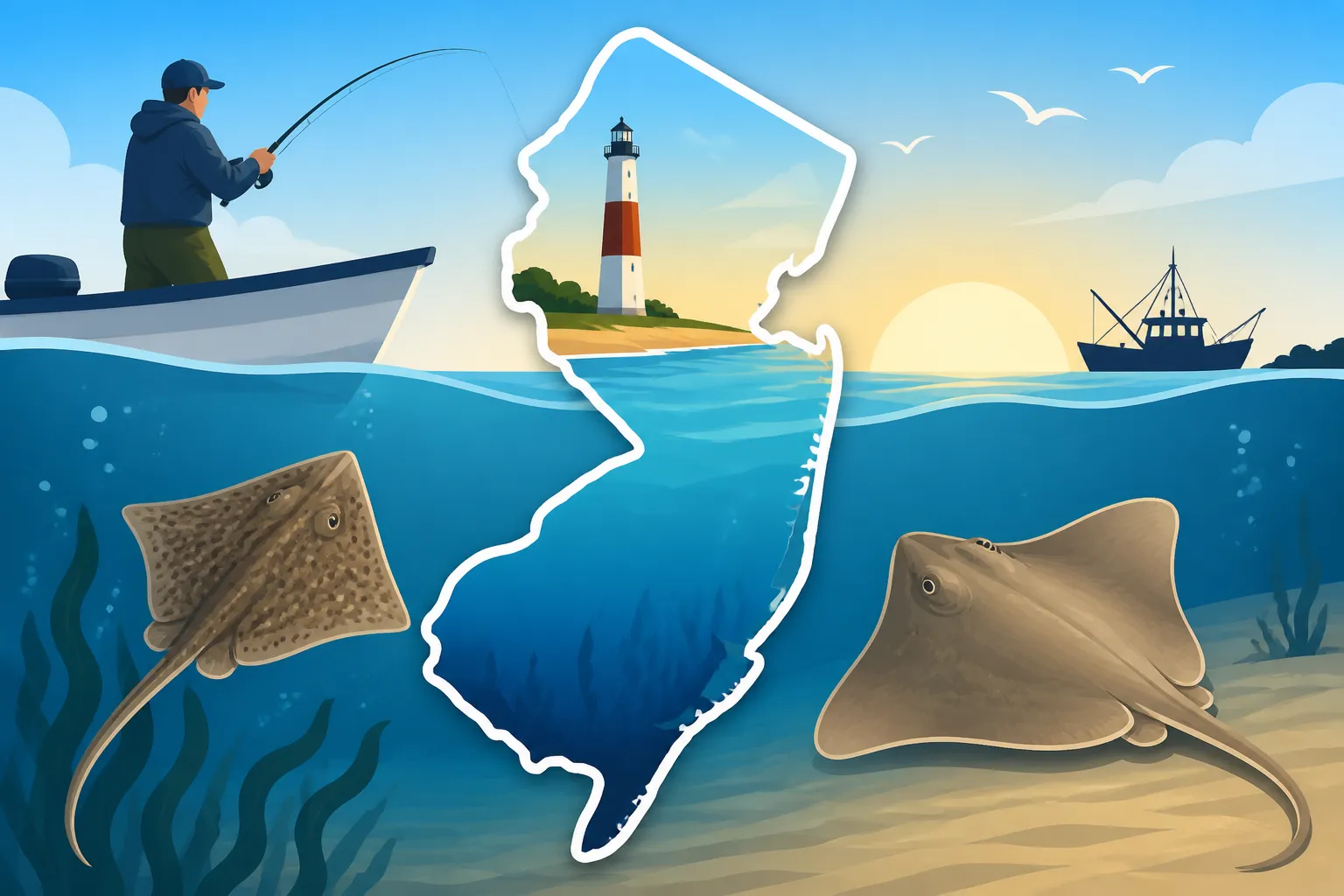
The Little Skate (Leucoraja erinacea) is probably the most common skate you'll encounter along the New Jersey coast. True to its name, it's on the smaller side, usually only growing to about 20 inches in length. Its body is somewhat oval-shaped, and it has a rough, prickly texture, especially on its upper surface. You'll often see distinct dark spots and blotches scattered across its brownish-grey back. Little skates are incredibly hardy and can be found from the shallowest bay waters out to deeper offshore areas, making them almost ubiquitous for bottom anglers. They're often mistaken for young rays, but remember that thorny tail without a barb, and those little egg cases you might find.
Another frequent visitor is the Winter Skate (Leucoraja ocellata). These skates are generally larger than the little skate, often reaching lengths of up to 40 inches or more, with a more rounded, robust disc shape. Their coloration can vary, but they often have a lighter brownish back with irregular, often somewhat ocellated (eye-like) spots, though these can be faint. Winter skates prefer cooler waters, so while you might catch them in shallower bay or surf zones during the cooler months, they tend to move to deeper, offshore areas as the water warms up in summer. They're a powerful fish when hooked, providing a decent fight on light tackle, though they're not typically sought after for food.
Then there's the Clearnose Skate (Raja eglanteria), which is perhaps the easiest to identify thanks to its namesake feature. This skate has distinct, translucent or "clear" patches on either side of its snout, almost like little windows. These clear spots are actually areas of thinner skin where you can see the underlying cartilage. Clearnose skates are medium-sized, typically growing to about 30 inches, and have a more diamond-shaped disc compared to the rounder little or winter skates. Their backs are usually a sandy brown color with some darker markings. They are commonly found over sandy or muddy bottoms in bays, estuaries, and nearshore ocean environments, often in slightly warmer waters than the winter skate.
Common Ray Species You Might Hook
While skates are often the more common flatfish to encounter, New Jersey waters also host several species of rays, some of which possess the notorious stinging barb. Understanding which rays are around and how to identify them is crucial for angler safety.
One of the most recognizable rays in our waters is the Cownose Ray (Rhinoptera bonasus). These rays are quite distinctive with their unique head shape, which features a deeply notched snout that gives them a somewhat bovine appearance, hence the "cownose" moniker. They are a migratory species, often appearing in large schools, sometimes numbering in the thousands, during the warmer months. Imagine seeing a massive school of these undulating across the surface of Barnegat Bay – it’s quite a sight! Cownose rays can grow quite large, with wingspans sometimes exceeding 3 feet, and they are powerful swimmers. They have a long, whip-like tail with a small, venomous barb located at the base. While generally not aggressive, a sting from a cownose ray can be extremely painful, so caution is advised. They are primarily clam and oyster eaters, so if you're fishing clam baits, you're definitely in their strike zone.
Less common, but certainly present, is the Southern Stingray (Hypanus americanus). This ray has a more classic diamond or kite-shaped disc, often uniformly brownish or grayish on top. What makes it particularly noteworthy is its prominent, venomous barb located on the tail, which is used purely for defense. Southern stingrays can grow to a substantial size, with disc widths sometimes reaching 5 feet across. They prefer sandy or muddy bottoms in shallow, warm waters, often burying themselves, making them hard to spot. While not as numerous as cownose rays in New Jersey, they are definitely here, especially in the southern parts of the state during summer. Always shuffle your feet when wading in shallow, warm bay waters to avoid stepping on one and getting stung.
Another ray you might confuse with the cownose is the Bluntnose Ray (Hypanus say). It shares some similarities with the cownose ray in its preference for shallow, coastal waters, but as its name suggests, it has a much blunter, less-notched snout. It also possesses a venomous barb on its tail. Bluntnose rays are generally smaller than cownose rays, typically maxing out around 2 feet in disc width. They are often found in estuaries and nearshore ocean environments, feeding on crustaceans and mollusks. While not as dramatically abundant as the schooling cownose rays, they are a consistent presence in our bays and sounds during the warmer months.
Here’s a quick comparison of some key features to help you differentiate these fascinating creatures:
| Feature | Skates (e.g., Little Skate, Winter Skate) | Rays (e.g., Cownose Ray, Southern Stingray) |
|---|---|---|
| Tail | Thicker, fleshier, usually with small dorsal fins, NO venomous barb | Thinner, whip-like, often with a venomous barb (e.g., Cownose, Southern Stingray) |
| Skin Texture | Rough, often with thorns, spines, or prickles | Smoother, less thorny (though some can have small denticles) |
| Reproduction | Lay leathery egg cases (mermaid's purses) | Give birth to live young (viviparous) |
| Mouth | Typically smaller, near the front of the head | Can be larger, often under the head |
| Movement | Propel themselves with caudal (tail) fin or by undulating margins of disc | "Fly" through the water by flapping their pectoral fins |
| Appearance | Often more rounded or heart-shaped disc | Often more diamond-shaped or angular disc |
Safe Handling and Respectful Release for Skates and Rays
Catching a skate or ray, especially if it's not your target, can be an exciting or sometimes startling moment. Whether you're intrigued by its unique appearance or just want to get it off your hook and back into the water quickly, safe handling is paramount – for both you and the fish. Remember, while most skates are harmless beyond their rough skin, certain rays possess a venomous barb, and even a non-venomous skate can give you a painful scrape with its teeth or spines.
Prioritizing Your Safety and Their Well-being
The first rule when you land any skate or ray is to exercise caution. Even if you're pretty sure it's a harmless skate, treat it with respect. Their bodies can be surprisingly powerful, and a thrashing fish can easily embed a hook further or cause an accidental scrape. For rays, particularly species like the cownose or southern stingray, the tail is the primary area of concern. Their barb is a defensive weapon, and they won't hesitate to use it if they feel threatened. This means keeping your hands, feet, and any other body parts well away from the tail.
Having the right tools at hand is absolutely critical. A good pair of long-nose pliers or a dehooker will allow you to remove the hook without ever getting your fingers near the fish's mouth or, more importantly, a ray's barb. Investing in a sturdy pair of fishing gloves, perhaps even cut-resistant ones you can find on Amazon, can also offer an extra layer of protection against rough skin, spines, or accidental slips. Some anglers also carry a small net or a specialized lip gripper (though these are less ideal for a wide-bodied skate or ray) to help control the fish. The goal is always to minimize direct contact with your hands while maximizing control of the fish. Think about it this way: you wouldn't try to dehook a bluefish without pliers, and a ray deserves the same, if not more, caution due to its unique defense mechanism.
Best Practices for Catch and Release
When it comes to releasing skates and rays, minimizing stress and ensuring their survival are key. These creatures are resilient, but rough handling can do serious harm. Once you've safely landed the fish and secured it, try to work quickly and efficiently. If possible, keep the fish in the water while you work to remove the hook. This drastically reduces their stress and exposure to air, which can be detrimental to their delicate gills. For larger skates or rays that might be too heavy to lift safely, a large net or even a wet towel placed over their eyes can help calm them down.
If the hook is easily accessible in the lip or corner of the mouth, use your long-nose pliers or dehooker to gently back it out. Barbless hooks, or hooks where you've crimped down the barb, are an absolute blessing when dealing with these fish, making removal much simpler. However, if the hook is deeply swallowed or in a precarious spot where removal would cause excessive damage, don't hesitate to simply cut the line as close to the hook as possible. Hooks made of stainless steel will eventually corrode and fall out, allowing the fish a much better chance of survival than a prolonged, damaging removal process. This is a common practice in catch-and-release fishing, especially for species like stripers caught deep, and it applies just as well to skates and rays. You might find a good selection of specialized cutting tools and dehookers on Amazon that can make this process smoother.
Finally, when you're ready to release, do so gently. Support the fish's body with both hands if you must lift it, avoiding holding it only by the tail or head. Gently slide it back into the water, allowing it time to orient itself before swimming away. Sometimes they'll sit on the bottom for a moment before gliding off. Observing these practices not only protects you but also shows respect for the incredible marine life that thrives in our New Jersey waters, contributing to the overall health of our fisheries. Remember, New Jersey catch and release rules often emphasize minimizing harm to the fish, and that philosophy extends to all species, whether targeted or not.
Why Skates and Rays Matter to New Jersey's Ecosystem
While they may not always be the most sought-after catch, skates and rays play a vital, often understated, role in the intricate web of life beneath New Jersey's waters. They are far more than just "trash fish" or bycatch; they are integral members of our marine community, contributing to the balance and health of the ecosystem.
Their Role in the Food Web
Skates and rays are quintessential bottom feeders, and this position in the food web makes them incredibly important. By constantly sifting through sandy and muddy bottoms, they help to control populations of various invertebrates like clams, oysters, marine worms, and crabs. Think of them as the vacuum cleaners of the seabed, diligently consuming organisms that, if left unchecked, could overpopulate certain areas. This natural "gardening" helps to maintain biodiversity and nutrient cycling within the benthos (the ocean floor).
Furthermore, despite their size, skates and rays themselves become prey for larger marine predators. Young skates and rays, in particular, can be a food source for larger fish species like sharks and even some marine mammals. Their broad, fatty bodies represent a significant caloric intake for anything large enough to consume them. This makes them a crucial link in the energy transfer from the lower trophic levels (bottom-dwelling invertebrates) up to the apex predators in the New Jersey marine ecosystem. Understanding their role helps us appreciate why their presence is a sign of a healthy and functioning marine environment.
Conservation and Awareness
The fact that skates and rays are so common in New Jersey waters sometimes leads to a perception that they are indestructible. However, many species of skates and rays are actually quite vulnerable to overfishing or habitat degradation. Their life histories often involve slow growth rates and delayed maturity, meaning that it takes a long time for them to reach reproductive age and replace their numbers. This makes them particularly susceptible to population declines if fishing pressure is too high or if their habitats are damaged.
Therefore, respectful handling and a conscious awareness of their importance are essential for their continued health. Catch-and-release practices, as outlined earlier, significantly contribute to their survival. Additionally, being informed about local regulations, even if you're not targeting them, helps ensure compliance with any species-specific rules that might exist. The New Jersey Division of Fish and Wildlife regularly monitors these populations, and reporting unusual catches or observations to them can contribute to valuable scientific data. Remember, every creature, from the smallest baitfish to the largest shark, plays a part in the grand scheme of our oceans. By treating skates and rays with care, we're not just being good anglers; we're being responsible stewards of New Jersey's incredible marine resources. For more information on what else you might encounter, you can always check out New Jersey Sea Robin and Bycatch Species or consult the New Jersey Fish and Wildlife Digest: Where to Find the Current Rules.
Disclaimer
This article is for general informational purposes only and does not constitute professional advice. Laws, prices and regulations vary by location and change over time. Consult a qualified professional for guidance on your specific situation.