Where Do Lake Trout Hold at Round Valley Reservoir?
Finding those elusive lake trout in Round Valley Reservoir can feel like searching for a needle in a haystack. This massive, deep lake holds some truly impressive lakers, but their tendency to move based on depth, temperature, and forage means anglers often feel like they’re just guessing. This guide is dedicated to demystifying where lake trout hold in Round Valley, offering detailed insights into their preferred habitats throughout the seasons, and equipping you with the knowledge to increase your chances of a successful catch.
The Unique Ecosystem of Round Valley Reservoir for Lake Trout
Round Valley Reservoir isn't just any body of water; it's a unique jewel in New Jersey's fishing crown. Understanding its specific characteristics is absolutely critical if you hope to consistently find and catch its legendary lake trout. These fish are creatures of habit and environmental preference, and Round Valley caters to their needs perfectly.
The Lake's Depth and Crystal-Clear Waters
One of the first things you'll notice about Round Valley is its incredible depth and astonishingly clear water. When you're out there, you can often see down 15, 20, even 30 feet on a calm day. This exceptional water clarity is a double-edged sword for anglers. On one hand, it's beautiful, making for a pleasant day on the water. On the other, it means lake trout, which are inherently wary, can spot you and your boat from a considerable distance. This forces them to seek deeper, darker haunts for comfort and security.
The maximum depth of Round Valley Reservoir can plunge well over 180 feet in certain spots, making it one of the deepest freshwater bodies in New Jersey. This incredible depth provides a consistent refuge for lake trout, particularly during warmer months when shallower waters become inhospitable. They thrive in cold, oxygen-rich environments, and the deep chasms of Round Valley offer exactly that, often maintaining single-digit water temperatures even in the height of summer. Knowing this, your focus should always be on understanding the contours of the lake bottom, rather than just cruising around the surface. If you're looking for more details on the lake itself, check out our guide on how deep is Round Valley Reservoir?
Understanding the Thermocline and Oxygen Zones
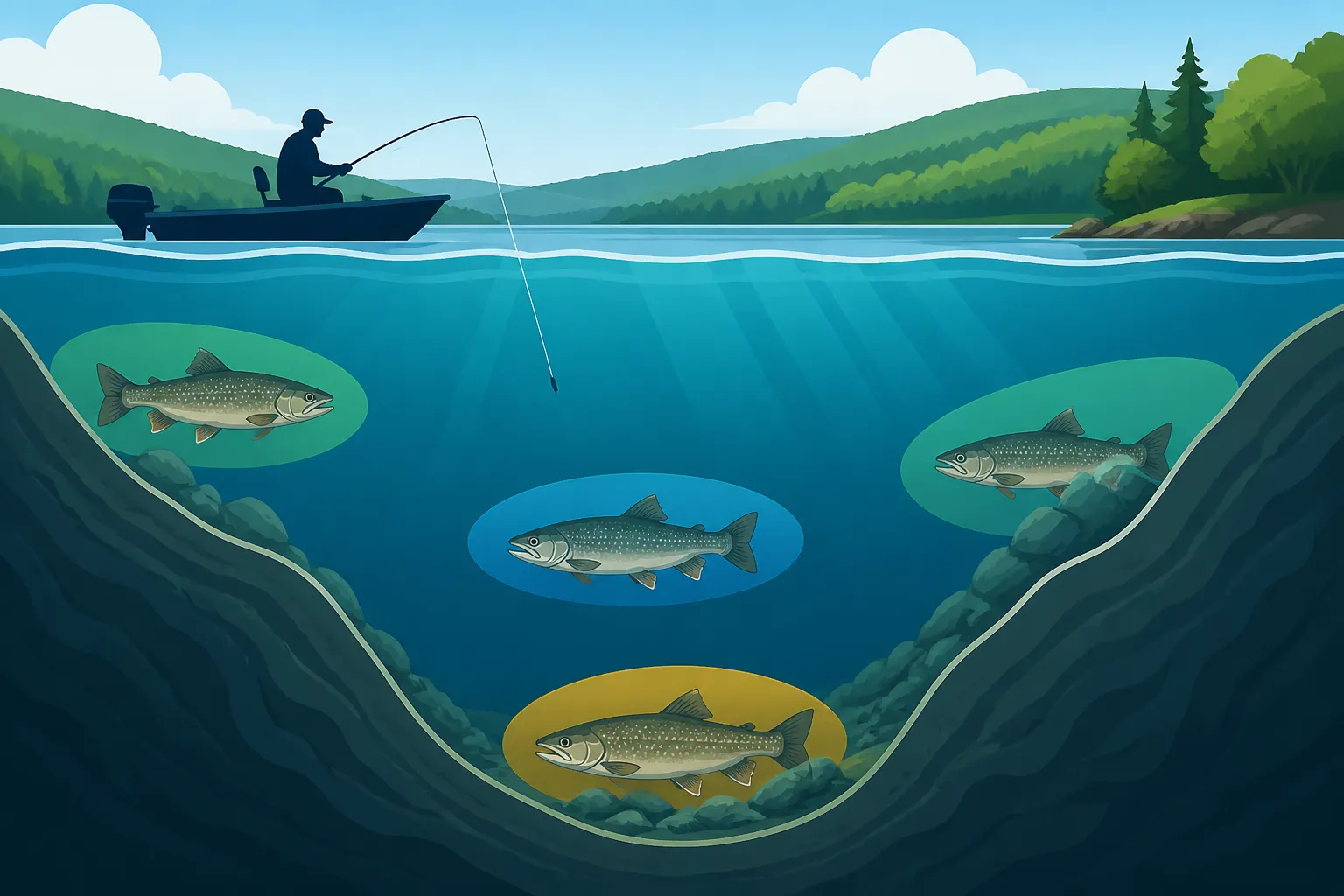
Another crucial concept for any serious lake trout angler at Round Valley is the thermocline. In deep, stratified lakes like Round Valley, the water column separates into distinct layers during the warmer months. The uppermost layer (epilimnion) is warm and well-oxygenated. Below that is the thermocline, a relatively thin layer where the water temperature drops rapidly. And beneath that is the hypolimnion, the deepest layer, which is consistently cold.
Lake trout are cold-water fish, preferring temperatures typically ranging from 45 to 55 degrees Fahrenheit. While they seek out the coldest water possible, they also need sufficient oxygen. In some very deep lakes, the deepest parts of the hypolimnion can become deoxygenated. At Round Valley, however, the incredible depth and constant turnover usually mean ample oxygen exists even in the colder, deeper zones. This allows lake trout to inhabit a wider range of depths within the hypolimnion, often congregating right above, within, or just below the thermocline where optimal temperature and oxygen levels meet. Understanding this transition layer is key to understanding their summer movements.
Prime Lake Trout Holding Structures in Round Valley
Lake trout are not nomadic wanderers; they relate heavily to structure. While they might roam open water in search of baitfish, they're rarely far from a distinct geological feature that offers ambush points, cover, or access to preferred depths. Round Valley is blessed with a variety of such structures.
Deep Drop-Offs and Submerged Ledges
These are arguably the most consistent lake trout magnets in Round Valley Reservoir. Picture a sharp drop-off where the bottom plunges from 40 feet to 80 feet, or a submerged ledge that creates a distinct shelf along the bottom. These areas act as underwater highways and feeding grounds. Lake trout will position themselves along these edges, often just outside the primary feeding zone, ready to ambush schools of baitfish that pass by. They can quickly move up or down the face of the drop-off to intercept prey or retreat to deeper safety.
When you're out on the water, spend ample time idling over areas where your sonar shows significant depth changes. Look for the "break lines" — where the bottom contours change dramatically. These can be found all around the perimeter of the main lake basin, particularly off the various points and shallower flats that extend into the deeper water. The transition zones are where the action often happens, as baitfish move from the open water to graze on shallower banks, and lake trout await.
Rocky Reefs, Humps, and the Main Lake Basin
Beyond the sharp drop-offs, Round Valley features a variety of more subtle underwater topography that lake trout adore. Rocky reefs and isolated humps, which might only rise a few feet off the bottom in 60 to 100 feet of water, can be absolute hotspots. These structures break up the otherwise flat bottom, providing complex cover and a place for smaller baitfish to hide, which in turn attracts the predators. Think of them as underwater oases in a vast desert.
The main lake basin itself, while appearing featureless on a basic map, has its own nuances. Subtle undulations, depressions, and slight changes in bottom composition can all attract lake trout. Sometimes, they'll simply suspend in the deeper open water, cruising just above the bottom, especially when actively chasing baitfish. This is where a good fish finder becomes invaluable, helping you mark not just the bottom, but also suspended fish and bait schools. Many experienced anglers, even those who hire a guide through services like FishingBooker, will tell you that paying attention to these subtle changes in the main basin can be as important as finding obvious structure.
The Dam Wall and Deepest Areas
The towering dam wall at Round Valley Reservoir is more than just an engineering marvel; it's a significant piece of lake trout habitat. The face of the dam plunges directly into some of the deepest water in the reservoir, creating an immense vertical structure that extends down into the frigid depths. This vertical wall offers a constant, steep drop-off, providing lake trout with easy access to varying depths and quick escapes.
Additionally, the area immediately surrounding the dam, including the deepest parts of the reservoir (those 150-180 foot zones), serves as a crucial sanctuary for lake trout, especially when pressure is high elsewhere or during the warmest months. These deep pockets of water maintain stable temperatures and oxygen levels year-round. While fishing directly against the dam face might sometimes be restricted or require caution due to safety regulations, the adjacent deep water is always worth exploring. For detailed regulations on fishing in New Jersey, including specific areas, it's always a good idea to consult the New Jersey Fish and Wildlife Digest.
Seasonal Shifts: Where to Find Lake Trout Year-Round
Lake trout are highly sensitive to water temperature, and their preferred holding depths will change dramatically with the seasons. What works in April won't necessarily work in August. Understanding these seasonal migrations is paramount to consistent success.
Spring and Fall: Shallow Water Opportunities
Ah, spring and fall – these are the golden times for many lake trout anglers at Round Valley. As the water cools in the fall and warms slightly in the spring (but not too much!), the lake undergoes what's called "turnover." This process mixes the water column, creating more uniform temperatures and oxygen levels from top to bottom. During these periods, lake trout are far less confined to the deep, frigid zones.
In spring, immediately after ice-out (if there was any significant ice, which is rare for Round Valley due to its depth), and in the early weeks before the water gets too warm, you'll find lake trout moving surprisingly shallow. They'll frequent depths of 20 to 50 feet, often cruising along shoreline breaks, points, and even inside larger bays, chasing baitfish. Similarly, in the fall, as the surface temperatures drop and approach those of the deeper water, lake trout move back up the water column, often feeding aggressively in similar depths. This is an excellent time for casting larger spoons, stickbaits, or even jigging around structure that was unfishable in summer. Remember, even during these shallower periods, they still appreciate proximity to deeper water for a quick retreat. Our guide on New Jersey Fishing Seasons Explained can give you a broader overview of seasonal changes for all species.
Summer's Deepwater Retreat
When the New Jersey summer heat sets in, Round Valley's lake trout disappear into the depths. This is when the thermocline establishes itself firmly, and the trout seek out that optimal combination of cold water and ample oxygen. You’ll find them concentrated in the hypolimnion, often between 60 and 120 feet deep, sometimes even deeper, depending on the day and the specific area of the lake.
During summer, lake trout will hold tight to deep structure, such as the underwater humps, steep drop-offs, and the main lake basin's deepest pockets. They are still actively feeding, but their movements are dictated by thermal comfort. Trolling techniques, often involving downriggers, lead core line, or heavy weights, become essential to get your lures down to where the fish are. Drifting with live bait or heavy jigs is also effective, but precision in depth control is key. This is a time when understanding your electronics, and perhaps even engaging with a local guide through platforms like FishingBooker, can make a huge difference, as finding that specific depth range is critical.
Winter's Widespread Distribution
While Round Valley Reservoir doesn't reliably freeze over for safe ice fishing like some shallower lakes, the winter months still bring a distinct change in lake trout behavior. With the entire water column cooled to near-uniform temperatures (often in the low 40s), the fish are no longer restricted by a thermocline. This means they can be found spread out across a wider range of depths, from 40 feet all the way down to the deepest parts of the lake.
During winter, lake trout might be less concentrated than during summer, but they are still catchable. They will continue to relate to the same deep structures—the drop-offs, humps, and the dam face—but they might also suspend in open water more frequently, slowly cruising for baitfish. Vertical jigging with heavy spoons or blade baits over deep structure, or slow trolling with deep-diving lures, can be effective. The key is to cover water at various depths until you locate a pattern. Even though it's cold, a dedicated angler can find great action.
Effective Strategies for Locating and Catching Round Valley Lake Trout
Finding lake trout in a vast, deep lake like Round Valley is only half the battle. Once you have a general idea of where they should be, you need the right tools and techniques to pinpoint them and entice a bite.
Mastering Your Sonar and Electronics
Let's be real: trying to consistently catch lake trout in Round Valley without a quality fish finder is like trying to navigate a dense fog without a compass. Modern sonar units are your eyes underwater. You need to understand how to read your screen to identify not just the bottom contours, but also suspended fish, bait balls, and the crucial thermocline layer. Look for sharp "arches" or distinct marks that indicate fish. Sometimes, lake trout will appear as elongated blobs if they're holding very close to the bottom.
Spend time idling over potential holding areas, scanning for structure and fish. Learn the difference between a school of baitfish (often appearing as a dense cloud) and individual larger fish. Mark waypoints on your GPS for any promising areas, whether it's a hump, a deep break, or a spot where you marked fish. This data will be invaluable for future trips and for understanding patterns. Utilizing a high-frequency chirp sonar can provide incredible detail, helping you distinguish between small baitfish and larger predators lurking below.
Following the Bait: Alewives and Other Forage
Lake trout are apex predators, and their movements are inherently tied to their food source. In Round Valley Reservoir, the primary forage for lake trout (and many other species) is the alewife. These small, silvery baitfish school up in immense numbers and represent a mobile buffet for the lakers. If you can locate schools of alewives, you are very likely to find lake trout nearby.
Your sonar will often show dense clouds of baitfish. Pay close attention to the depth at which these baitfish are holding, and then focus your efforts just below or on the edges of these schools. Lake trout will often position themselves beneath the bait, attacking from below. Besides alewives, lake trout will also opportunistically feed on juvenile perch, shiners, or even other trout, so understanding the entire forage base is beneficial. Observing bird activity, particularly gulls diving, can sometimes indicate baitfish pushed to the surface, which is a rare but exciting clue for shallower laker activity in spring or fall.
Recommended Techniques and Tackle
When it comes to actually getting a bite, precision and persistence are key. For deep-water lake trout in Round Valley, trolling is often the most effective method, especially during the summer.
- Trolling: This involves pulling lures behind a moving boat. To reach the depths where lake trout hold, you'll need specialized gear.
- Downriggers: These devices use a heavy weight and cable to precisely control the depth of your lure. They allow you to present baits right in the fish zone.
- Lead Core Line: This colorful line changes color every 10 yards, with each color representing roughly a few feet of depth at a specific speed. It's a low-tech way to get lures deep without downriggers.
- Heavy Trolling Weights: Using specialized trolling sinkers like Guppy weights or three-way rigs can also get lures down.
- Lures: Large spoons (e.g., Sutton Spoons, Mooselook Wobblers, Apex Trolling Lures), stickbaits (like Rapalas or Bombers), and even large tube jigs trolled slowly are all effective. Our guide on Trolling Techniques for New Jersey Lake Trout delves deeper into these methods.
- Jigging: Vertical jigging can be incredibly effective, especially when you mark fish directly beneath the boat over structure. Heavy jigging spoons, blade baits, or large tube jigs tipped with bait (like a piece of alewife or gulp) dropped directly to the fish's depth can trigger strikes.
- Live Bait: Live alewives, shiners, or large fathead minnows fished on a three-way rig or suspended under a balloon can be irresistible to lakers. This is a common and highly effective technique, especially when fish are less active.
Regardless of the technique, use stout tackle. Lake trout can grow quite large in Round Valley – often exceeding 10 pounds – so a medium-heavy rod with a reliable reel spooled with 15-20 pound test monofilament or braided line is advisable. Always have a good quality landing net to safely handle these powerful fish. For those new to the sport, our guide to the Best New Jersey Fishing Gear for Beginners can help you choose the right setup. And remember, when you're out there, ensure you have your New Jersey Fishing License Guide for 2026 and any required stamps, like the New Jersey Trout Stamp Requirements Explained, readily available.
Round Valley Lake Trout Holding Patterns by Season
| Season | Typical Holding Depth | Preferred Structures | Recommended Techniques |
|---|---|---|---|
| Spring | 20-60 feet | Shoreline breaks, points, shallower humps, flats adjacent to deep water | Trolling spoons/stickbaits, casting jigs/spoons, live bait |
| Summer | 60-120+ feet (below thermocline) | Deep drop-offs, main lake basin humps, dam wall, deepest channels | Downrigging, lead core trolling, vertical jigging heavy lures |
| Fall | 30-80 feet | Deep points, main lake basin structure, steeper drop-offs, baitfish schools | Trolling spoons/stickbaits, jigging, live bait |
| Winter | 40-120+ feet | Deep structure, subtle changes in main basin, suspended near bait | Vertical jigging, slow trolling deep lures |
This table provides a general overview, but remember that lake trout are still wild animals, and daily conditions (weather, barometric pressure, bait movements) can always cause variations.
Finding and catching lake trout in Round Valley Reservoir is a rewarding challenge that requires patience, the right gear, and a solid understanding of the lake's unique characteristics. By focusing on deep, cold, oxygenated waters, learning to read your electronics, and adapting your techniques to the season, you'll dramatically improve your chances of hooking into one of these magnificent fish. It's a journey of discovery on the water, and every trip teaches you something new about this incredible fishery.
Disclaimer
Fishing regulations, including size limits, bag limits, and season dates, can change. Always consult the latest New Jersey Fish and Wildlife Digest or visit the official NJDEP Fish and Wildlife website before heading out. This guide is for informational purposes only and does not constitute legal advice.