Fishing License Reciprocity Between New Jersey and Neighboring States
It can be incredibly confusing trying to figure out which fishing license you need when you're casting lines in waters that border two states, like the mighty Delaware River or the expansive Delaware Bay. Many anglers worry about accidentally breaking the law or buying multiple, unnecessary licenses. This guide is here to clear up all that uncertainty, offering a deep dive into New Jersey's fishing license reciprocity agreements with its neighbors—Pennsylvania, New York, and Delaware—so you can fish with confidence.
What Exactly is Fishing License Reciprocity?
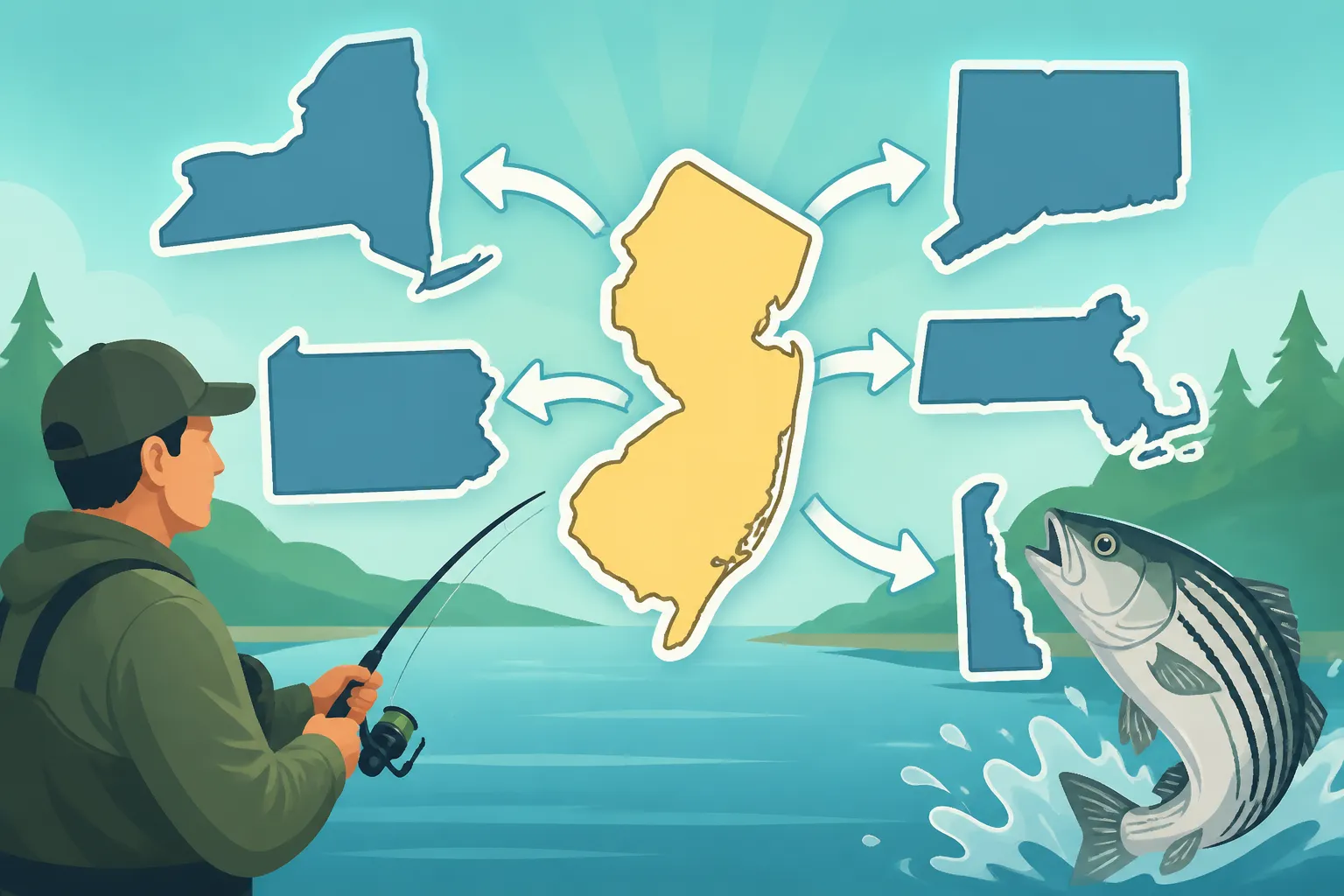
Fishing license reciprocity, in simple terms, is when two or more states agree to mutually recognize each other's fishing licenses within certain shared boundary waters. It's designed to make life easier for anglers who want to fish a river or bay that serves as a border between states, preventing them from having to purchase multiple licenses just to fish the same body of water from a different bank or by crossing an invisible line in the middle. Without these agreements, you'd potentially need both a New Jersey and a Pennsylvania license just to fish the Delaware River, which would be a real hassle and an extra expense for many of us.
The Idea Behind Shared Water Agreements
The core idea is pretty straightforward: if a natural waterway forms a state boundary, it makes sense for both states to come to an understanding. Imagine trying to police who's fishing on "their side" of the river when a fish could swim across in a second! These agreements acknowledge that for practical purposes, these waters are shared resources. They are born out of necessity and a desire to promote recreational fishing without creating undue burdens for enthusiasts. It also often comes with shared conservation efforts, where both states might agree on certain fishing regulations for those specific reciprocal waters to ensure the health of the fish populations. It's a pragmatic solution to a geographical challenge.
Why Reciprocity Doesn't Cover All Waters
It's crucial to understand that reciprocity is almost never a blanket rule for all waters in neighboring states. It's very specific, applying only to the actual shared boundary waters. For instance, while your New Jersey license might be valid in certain parts of the Delaware River bordering Pennsylvania, it absolutely will not cover you if you decide to fish a small lake or stream entirely within Pennsylvania's borders. Similarly, a Pennsylvania license won't let you fish a New Jersey inland lake like Lake Hopatcong. Each state still wants to manage its own internal fisheries and collect license fees for those efforts. The agreements are surgical, not sweeping. Always double-check the exact boundaries and specific rules, because fishing regulations can be complex, and ignorance of the law is never an excuse if a conservation officer checks your credentials.
New Jersey and Pennsylvania: Delaware River Rules
The Delaware River is arguably the most significant body of water affected by reciprocity agreements for New Jersey anglers. This majestic river forms a long stretch of the border between New Jersey and Pennsylvania, making shared access absolutely essential for anyone who loves to fish its diverse waters, from the trout streams up north to the tidal sections down south.
Understanding the Delaware River Main Stem Agreement
For the main stem of the Delaware River, there's a fantastic agreement in place that simplifies things considerably. If you possess a valid fishing license from either New Jersey or Pennsylvania, you are generally covered to fish the main stem of the Delaware River, regardless of which side you're on, or even if you're in a boat in the middle of the river. This means if you're a New Jersey resident with a New Jersey fishing license, you can fish from the Pennsylvania bank, or launch a boat from either state and fish the entire width of the river, without needing to buy a separate Pennsylvania license. This is a huge benefit, especially for those who live near the border and might frequent both sides.
However, there are critical nuances. This reciprocity only applies to the main stem of the Delaware River. It does not extend to any tributaries, streams, or lakes that flow into the Delaware River but are entirely within the borders of one state or the other. For example, if you fish the Musconetcong River in New Jersey, you need a New Jersey license. If you then decide to fish a creek that flows into the Delaware on the Pennsylvania side, you would need a Pennsylvania license for that specific creek. This distinction is vital to avoid any fines or legal issues. Our guide on whether Do You Need Two Licenses to Fish the Delaware River Between New Jersey and Pennsylvania? dives even deeper into this specific scenario, offering more clarity.
Specific Trout Stamp and Other Endorsement Considerations
While the general fishing license might be reciprocal on the main stem of the Delaware River, special endorsements like trout stamps can sometimes be a different story. In New Jersey, if you plan to keep trout from waters that are designated as trout-stocked, you generally need a New Jersey Trout Stamp. The question then becomes, does a Pennsylvania trout stamp cover you for trout fishing on the Delaware River's main stem if you're a New Jersey angler, and vice-versa?
Historically, if you possess a valid fishing license from either New Jersey or Pennsylvania, along with any necessary trout stamp from the state that issued your base license, you are covered for trout fishing on the main stem of the Delaware River. This means if you have a New Jersey fishing license and a New Jersey Trout Stamp, you're good to go for trout on the main stem. The reciprocal agreement typically extends to the trout stamp if it's issued by the same state as your base fishing license. Always refer to the most current New Jersey Fish and Wildlife Digest for the precise wording, as these rules can occasionally be updated. It's a subtle but important detail that can catch anglers off guard. You'll find more details about general trout requirements in our article on New Jersey Trout Stamp Requirements Explained.
New Jersey and New York: Shared Waters
New Jersey and New York also share certain border waters, most notably sections of the Hudson River and some smaller streams in the northern part of the state. These agreements, while perhaps less expansive than those with Pennsylvania for the general public, are equally important for anglers living and fishing in those specific regions.
Hudson River and Raritan Bay Reciprocity
The Hudson River, particularly its lower tidal reaches where it borders New Jersey, has specific reciprocal agreements. For anglers fishing from a boat or on the New Jersey side of the river up to the George Washington Bridge, a valid New Jersey fishing license is required. However, in many shared sections, New Jersey and New York honor each other's licenses. This means a New York fishing license might be recognized in specific parts of the Hudson River that New Jersey claims, and vice-versa. It’s important to note that these arrangements often come with specific geographical markers, so knowing your exact location is key.
Raritan Bay, though primarily within New Jersey, borders Staten Island, New York. For most of Raritan Bay, a New Jersey saltwater registry and, if you're a New Jersey resident, a New Jersey fishing license (if required for the species or method) is sufficient. However, for waters that are clearly New York territory, or if you launch from the New York side, you would typically need a New York license and/or saltwater registry, as applicable. The exact lines can get blurry near the entrance to the Arthur Kill and Kill Van Kull. For a detailed look at some of the popular fishing spots in this area, you might want to check out our guide to Raritan Bay and Sandy Hook Bay Fishing Guide.
What About the Tidal Tributaries?
Just like with Pennsylvania, the reciprocity agreements with New York generally do not extend to tidal tributaries or any body of water that lies entirely within one state's jurisdiction. If you venture into a creek or river that feeds into the Hudson but is solely within New Jersey, you'll need your New Jersey fishing license. The same applies if you cross over into a tributary that is exclusively New York's.
For example, if you're fishing the Hackensack River or the Passaic River, which are entirely within New Jersey, you absolutely need a New Jersey freshwater fishing license. These are not considered part of the shared border waters for reciprocity purposes. Always be mindful of whether the water you're fishing is a primary border waterway or an internal tributary. The details can be found in the current New Jersey Fish and Wildlife Digest, which is available online and through bait and tackle shops, sometimes even on a helpful device like a tablet you might have picked up from Amazon for planning your trips.
New Jersey and Delaware: Delaware Bay Specifics
The Delaware Bay is a vast estuary that forms the watery boundary between the southern tip of New Jersey and the state of Delaware. Fishing here is incredibly popular, especially for fluke, striped bass, and drum. Given its shared nature, understanding the reciprocity between New Jersey and Delaware for the bay is paramount for countless anglers.
The Delaware Bay Reciprocity Agreement
For recreational fishing in the shared waters of the Delaware Bay, there's a long-standing reciprocal agreement between New Jersey and Delaware. This means that if you possess a valid fishing license (and any required endorsements, such as a trout stamp if applicable, though trout stamps are less relevant for the bay) from either New Jersey or Delaware, you are generally permitted to fish the entire bay. This applies whether you're fishing from a boat, kayak, or even from the shore on either side of the bay, provided you don't enter a tributary or bay-side lake that is entirely within one state's territory. This is a huge convenience, especially for boaters who might drift across state lines without even realizing it.
However, anglers should be aware that while the license itself might be reciprocal, specific bag and size limits can sometimes differ slightly between the two states for certain species. It is generally recommended that anglers abide by the regulations of the state from which they launched their vessel or accessed the bay. For example, if you launch your boat from a New Jersey marina, you should follow New Jersey's bag and size limits for species like fluke, even if you drift into water that might be considered Delaware's side of the bay. This specific point about varying limits within the reciprocal waters is something many anglers find confusing, and it's always best to err on the side of caution and follow the more restrictive rule. Our guide on New Jersey Fishing License Validity in Delaware Bay Waters offers even more specific information on this topic.
Special Considerations for the Saltwater Registry
Beyond the basic fishing license, both New Jersey and Delaware have systems for saltwater angler registration. New Jersey requires all saltwater anglers to register with the state's Saltwater Registry Program, which is free. This is separate from your freshwater fishing license. While the general fishing license might be reciprocal, the saltwater registration status requires a bit more attention.
If you are a New Jersey resident fishing in the Delaware Bay, you must be registered with the New Jersey Saltwater Registry. If you are a Delaware resident, you would typically need to comply with Delaware's equivalent saltwater registration requirements. The reciprocity primarily covers the fishing license, not necessarily the registration itself. It's a critical distinction. The New Jersey registry is designed to gather important data for federal fisheries management, and it's a separate requirement. If you’re a New Jersey resident, make sure you've completed your free New Jersey Saltwater Registry Program Requirements before hitting the bay. Similarly, if you're a non-resident visiting from, say, Pennsylvania, and fishing the Delaware Bay, you would need to get either a New Jersey fishing license and register with the New Jersey Saltwater Registry, or ensure your home state's license is honored AND comply with its saltwater registration equivalent. It's a bit of a bureaucratic maze, but it's essential for compliance.
Understanding State-Specific Regulations Within Reciprocal Waters
While reciprocity agreements simplify the licensing aspect for shared waters, they don't always align the actual fishing regulations. This is where many anglers can get tripped up. It's not enough to just have the right license; you also need to know the specific rules about what you can catch and how much.
Discrepancies in Bag and Size Limits
One of the biggest areas of confusion within reciprocal waters is the difference in bag and size limits for various fish species. For example, New Jersey might have a specific size limit for striped bass or fluke that differs slightly from Pennsylvania or Delaware's regulations, even when fishing the same stretch of the Delaware River or Bay. This can create a tricky situation for anglers.
Generally, the recommendation is to adhere to the regulations of the state from which you launched your boat or accessed the water. So, if you're launching a boat from a ramp in New Jersey to fish the Delaware River, you should follow New Jersey's current bag and size limits, regardless of whether you drift to the Pennsylvania side of the river. This ensures you're always on the right side of the law, even if Pennsylvania's limits might be more generous that day. Always refer to the most recent official regulations for the state you are primarily fishing in. For New Jersey, this is the annual New Jersey Fish and Wildlife Digest. You can easily find the digest online or pick up a physical copy at many bait and tackle shops.
Equipment and Method Restrictions
Beyond bag and size limits, states can also have differing rules regarding allowed fishing equipment and methods, even in reciprocal waters. For instance, one state might permit certain types of nets or traps that the other state prohibits, or have different regulations on the number of rods an individual can use. New Jersey has specific rules regarding things like circle hooks for certain species like striped bass, which might not be identically mirrored in neighboring states.
It's a good practice to research both states' regulations if you anticipate fishing near the border, especially if you plan to use specialized gear or techniques. If you're buying new gear, like a specific type of reel or rod setup you found on Amazon, it's worth a quick check to make sure it complies with the regulations of both states if you plan on fishing reciprocally. A quick search on the New Jersey Fish and Wildlife website, or a call to their regional offices, can clear up any doubts. Ignorance of these subtle differences won't prevent a citation, so diligent preparation is key.
Here's a quick summary table for common reciprocal scenarios:
| Shared Waterway | States Involved | License Reciprocity? (Base License) | Trout Stamp Reciprocity? (If base license state issues it) | Saltwater Registry Reciprocity? | Follow Which State's Bag/Size Limits? |
|---|---|---|---|---|---|
| Delaware River (Main Stem) | NJ & PA | Yes | Yes | N/A (Freshwater) | State of Access/Launch |
| Delaware Bay | NJ & DE | Yes | N/A (Saltwater) | No (state-specific registry needed) | State of Access/Launch |
| Hudson River (Shared Tidal) | NJ & NY | Varies by specific section/agreement | N/A (Saltwater/Tidal) | No (state-specific registry needed) | State of Access/Launch |
Note: This table provides a general overview. Always consult the most current regulations from the New Jersey Division of Fish and Wildlife and its neighboring state counterparts before fishing.
Common Misconceptions and Avoiding Penalties
Fishing in reciprocal waters can be a fantastic experience, offering diverse angling opportunities. However, the complexities of multi-state regulations also lead to common misconceptions that can, unfortunately, result in citations and fines. Understanding these pitfalls is crucial for a smooth and enjoyable trip.
The "Universal License" Myth
Perhaps the most common misconception is the idea that if you have a license from one state, it’s somehow "universal" for any bordering water or even any water in a neighboring state. As we've thoroughly discussed, this is absolutely not true. Reciprocity is highly specific to designated shared boundary waters, like the main stem of the Delaware River or the open expanse of the Delaware Bay. It does not extend to internal lakes, streams, or even tributaries that feed into these shared waters but lie entirely within one state's borders. Thinking your New Jersey Fishing License Guide for 2026 covers you to fish a Pennsylvania trout stream is a recipe for trouble. Always confirm the exact geographical boundaries where reciprocity applies.
Another aspect of this myth is assuming your license covers you for all types of fishing. Remember, freshwater licenses are distinct from saltwater registration requirements. Just because your New Jersey freshwater license covers you on the Delaware River doesn't mean you don't need to comply with saltwater registry rules if you shift to the Delaware Bay, for example. Understanding these distinctions is fundamental to avoiding penalties, and our article on Freshwater vs Saltwater Fishing Rules in New Jersey explains these differences in detail.
Consequences of Fishing Without Proper Licensing
Getting caught fishing without the proper license or without adhering to the correct regulations in reciprocal waters can lead to a range of unpleasant consequences. The exact penalties can vary depending on the state, the severity of the offense, and whether it's a first-time violation or a repeat offense.
Typically, you can expect fines, which can range from minor to significant. In New Jersey, the Penalties for Fishing Without a License in New Jersey can include monetary fines, and in some cases, your fishing gear might even be confiscated. Repeat offenses can lead to much heavier fines, suspension of your fishing privileges for a period, or even potential jail time in extreme cases, though this is rare for a first-time license violation. Beyond the legal consequences, there's also the embarrassment of being cited by a conservation officer and the potential loss of your fishing day. It's simply not worth the risk. Always carry proof of your license, whether it's a physical copy or a digital one on your phone, as our guide to Carrying Proof of Your New Jersey Fishing License advises.
How to Stay Informed and Compliant
Staying informed is your best defense against inadvertently breaking fishing laws. Here are some actionable tips:
- Consult Official State Resources: Always, always refer to the official New Jersey Division of Fish and Wildlife website. They publish the annual New Jersey Fish and Wildlife Digest, which contains all current regulations, including those for reciprocal waters. The websites of Pennsylvania Fish and Boat Commission, New York State Department of Environmental Conservation, and Delaware Division of Fish and Wildlife are equally important for their respective state's rules.
- Download the Digest: Many states offer downloadable PDF versions of their fishing regulations. Have it saved on your phone or printed out for easy reference, especially when you're out on the water.
- Local Bait and Tackle Shops: These are invaluable resources. Shop owners and staff are usually avid anglers themselves and are often the first to know about regulation changes or specific local nuances. They can tell you exactly what you need for the particular stretch of water you're planning to fish. You can often find a good selection of fishing maps and local guides there too, or even through online retailers like Amazon.
- Ask Questions: If in doubt, call the state's fish and wildlife agency. They are there to help and would rather answer a question than issue a citation.
- Check for Updates: Regulations can change mid-season, especially for federally managed species like striped bass or black sea bass. Always check for emergency rule changes before heading out, particularly if you haven't fished in a while.
By taking these steps, you can ensure your fishing adventures in New Jersey's reciprocal waters are not only fruitful but also fully compliant with the law, giving you peace of mind to enjoy your time on the water.
Disclaimer
Please remember that fishing regulations and reciprocity agreements can change. While this guide provides comprehensive information based on current understandings, it is your sole responsibility to consult the most up-to-date official regulations published by the New Jersey Division of Fish and Wildlife and the corresponding agencies in neighboring states before you go fishing.