New Jersey Black Sea Bass Season Dates
Keeping track of New Jersey's fishing regulations can feel like a full-time job, especially when it comes to popular species like black sea bass. One minute you've got a season, the next there's a closure, or the bag limits have shifted again. It's enough to make even the most seasoned angler scratch their head in frustration! This comprehensive guide is here to untangle the complexities of the New Jersey black sea bass season dates, explain how these rules are set, and help you prepare for a successful and compliant fishing experience.
Navigating New Jersey Black Sea Bass Season Dates and Limits
The black sea bass fishery in New Jersey is incredibly popular, and for good reason—these feisty fish are a blast to catch and even better on the dinner plate. However, managing this fishery is a delicate balance, and that often means regulations can be dynamic. When you're planning your trips, knowing the current and upcoming season dates and limits is paramount to avoiding a costly ticket or, more importantly, contributing to the sustainable future of this species.
Understanding the Multi-Segmented Season Structure
Unlike some other species that might have one continuous season, New Jersey's recreational black sea bass season is typically broken down into multiple segments throughout the year. This approach allows fishery managers to allocate fishing opportunities while still managing the overall harvest to keep the stock healthy. You might see a spring season, followed by a summer closure, then a fall season, and sometimes even a winter segment. Each of these segments can have different bag limits (how many fish you can keep) and minimum size limits (how long a fish must be to be legal).
For instance, looking at recent years, New Jersey has often implemented a spring season that might run from mid-May to mid-June, followed by a summer closure, then a much longer fall season that could span from mid-July through December. These are just examples, of course, and the exact dates, lengths of seasons, and specific bag and size limits are subject to change each year based on stock assessments and federal guidelines. It's vital to remember that these rules are set by the New Jersey Department of Environmental Protection's Division of Fish and Wildlife (NJDEP Fish and Wildlife) in conjunction with federal mandates from the Mid-Atlantic Fishery Management Council (MAFMC) and the Atlantic States Marine Fisheries Commission (ASMFC). Always consult the latest Reading the New Jersey Fish and Wildlife Digest for the most current information.
Why Black Sea Bass Regulations Evolve Annually
It can be incredibly frustrating to check the regulations only to find they've changed since your last trip. Trust me, I get it. But there's a very important reason behind these annual adjustments: conservation and sustainability. Black sea bass are managed at a regional level along the entire Atlantic coast, meaning New Jersey's rules are influenced by what's happening from North Carolina to Maine. Each year, scientists conduct stock assessments to determine the health of the black sea bass population. They look at things like how many fish are out there, how many are reproducing, and how many are being caught by recreational and commercial anglers.
Based on these assessments, the MAFMC and ASMFC set annual catch limits (ACLs) for the entire region. This "pie" is then divided among the states, and each state, including New Jersey, must develop regulations that are projected to stay within their allocated portion of the catch. Factors like overall stock health, recent catch rates, and even proposals from angler groups can all play a role in shaping the final regulations. So, while it feels like the rules are always moving targets, they're actually a calculated effort to ensure that we'll have healthy populations of black sea bass to fish for generations to come. This also means that providing exact 2026 dates right now is impossible, as they won't be finalized until closer to that year, but you can expect a similar multi-segment structure. It's always a good idea to stay informed through official channels like the NJDEP Fish and Wildlife website for the most up-to-date information on New Jersey Fishing Season Dates and Closures and New Jersey Daily Bag Limits by Species.
Preparing for Your Black Sea Bass Adventure
Knowing the season dates is only half the battle; being properly equipped and understanding the fish's habits are crucial for a successful day on the water. Black sea bass are structure-oriented fish, meaning they love to hang out around anything that provides cover, like reefs, wrecks, and rocky bottoms.
Essential Gear for Targeting Black Sea Bass
To effectively target black sea bass, you'll want a versatile setup that can handle their strong tug and the varied bottom structures they inhabit. A medium-light to medium-heavy spinning or baitcasting rod, typically 6 to 7 feet long, is ideal. Pair that with a reel capable of holding 200-300 yards of 20-30 lb braided line. Braid offers sensitivity to detect subtle bites and the strength to pull fish away from snags. Always tie on a 2-4 foot fluorocarbon leader of 20-30 lb test, which is nearly invisible underwater and abrasion-resistant against rough structures.
When it comes to terminal tackle, a high-low rig with two hooks (sizes 1/0 to 3/0) and a sinker on the bottom is a classic choice, especially when bait fishing. For artificials, bucktail jigs ranging from 1/2 ounce in shallow bays to 4 ounces in deeper, strong current areas are incredibly effective. Adding a soft plastic or Gulp! bait to your bucktail can significantly increase your strike rate. You can find a fantastic selection of these jigs, soft plastics, and even pre-tied rigs on Amazon, often at competitive prices, making it easy to stock up before your next trip. Having a good set of pliers, a sharp knife, and a cooler with ice are also non-negotiable for a safe and enjoyable outing. If you're looking to dive deeper into rigging, check out guides on How to Jig for Striped Bass, as many of the principles for jigging apply to sea bass as well.
Top Baits and Lures That Attract Black Sea Bass
Black sea bass aren't usually picky eaters, which is great news for anglers. However, some baits and lures definitely outperform others. Fresh clam strips are arguably the king of black sea bass baits. Their strong scent and tender texture are irresistible. Squid strips are another excellent choice, offering durability and a good visual presence. Small pieces of cut baitfish like mackerel or bunker can also work wonders, especially if you're looking for a slightly larger bite.
For artificial lures, bucktail jigs, as mentioned earlier, are fantastic. The key with bucktails is working them near the bottom with a jigging motion – lifting your rod tip and letting the jig fall, mimicking a wounded baitfish or crustacean. Tipping your bucktail with a piece of Gulp! (chartreuse, white, or pink are popular colors) can make it even more enticing. Small metal jigs or even soft plastic grub tails fished on a lead head jig can also be very effective, especially when the fish are aggressive. Remember, presenting your bait or lure right in their strike zone, which is usually right on or very close to the bottom, is crucial. You can learn more about specific techniques in our guide on How to Fish for Black Sea Bass Near Reefs.
Prime Locations for Black Sea Bass in New Jersey
Black sea bass are not random roamers; they are structure magnets. Understanding their preferred habitats is key to locating them, whether you're fishing from your own boat or hopping on a local charter.
The Allure of Reefs, Wrecks, and Rubble
In New Jersey, black sea bass thrive in areas with abundant hard structure. This includes natural rock formations, but perhaps more famously, the state's extensive network of artificial reefs. These reefs are purposefully created habitats made from old ships, concrete, and other materials, designed to attract marine life and provide excellent fishing opportunities. Popular reef sites like the Axel Carlson Reef, Barnegat Light Reef, and Atlantic City Reef are renowned for their sea bass populations. These underwater oases provide shelter from currents, ambush points for feeding, and a place for their prey to hide.
Fishing these areas often means using a boat equipped with a good fish finder to pinpoint the structure. Once you're over the desired spot, anchoring up-current and letting your baits or jigs drift over the structure is a common and effective technique. If you don't have a boat, consider joining a party boat or charter. Many New Jersey Deep Sea Fishing Charters and Jersey Shore Party Boat Fishing Guide services specifically target these reef and wreck sites, providing all the gear and expertise you need to get on the fish. For more detailed information, our New Jersey Artificial Reef Fishing Guide is an excellent resource.
Depths and Tides: Reading the Water for Better Bites
The depth at which you find black sea bass can vary quite a bit depending on the season and water temperature. In the cooler spring and fall months, they might be found in shallower waters, sometimes as little as 20-30 feet, especially if there's good structure present. During the peak summer heat, they tend to move to deeper, cooler waters, often congregating in 60-120 feet or more. However, this isn't a hard and fast rule; local knowledge and checking with bait and tackle shops can provide invaluable real-time insights.
Tides and current are also significant factors. Black sea bass are often more active when there's a good current, as it brings food to them and helps them ambush prey. The hour or two leading up to and after a tide change, whether high or low, can often trigger a strong bite. When jigging, you need enough weight to get your lure to the bottom and keep it there, but not so much that it's difficult to impart action. Adjusting your jig or sinker weight based on the strength of the current is a fundamental skill for successful sea bass fishing. Understanding How to Read Tide Charts for Better Fishing in New Jersey can significantly improve your fishing success.
Staying Compliant and Practicing Responsible Angling
Beyond knowing when and where to fish, it's every angler's responsibility to understand and adhere to the regulations. This ensures that everyone can enjoy this fantastic fishery for years to come.
The Importance of the New Jersey Saltwater Registry
First and foremost, if you're planning to fish for black sea bass or any other saltwater species in New Jersey, you absolutely need to be registered with the New Jersey Saltwater Recreational Registry Program. This is a crucial, free registration that is separate from a freshwater fishing license. Many anglers mistakenly believe that if they only fish saltwater, they don't need anything, but that's not true. The registry helps the state and federal agencies collect vital data on recreational fishing effort, which in turn influences future regulations. It's a simple process that takes just a few minutes online. You can learn more about it in our guide, New Jersey Saltwater Registry Explained, and detailed instructions on How to Register for New Jersey's Saltwater Registry Program.
Even if you're fishing on a party boat or a charter, where the vessel itself holds a federal permit, it's still your responsibility to understand the individual angler requirements. While the boat covers the federal registry, knowing the state's rules, like bag and size limits, is still on you.
Identifying Your Catch and Ethical Release Practices
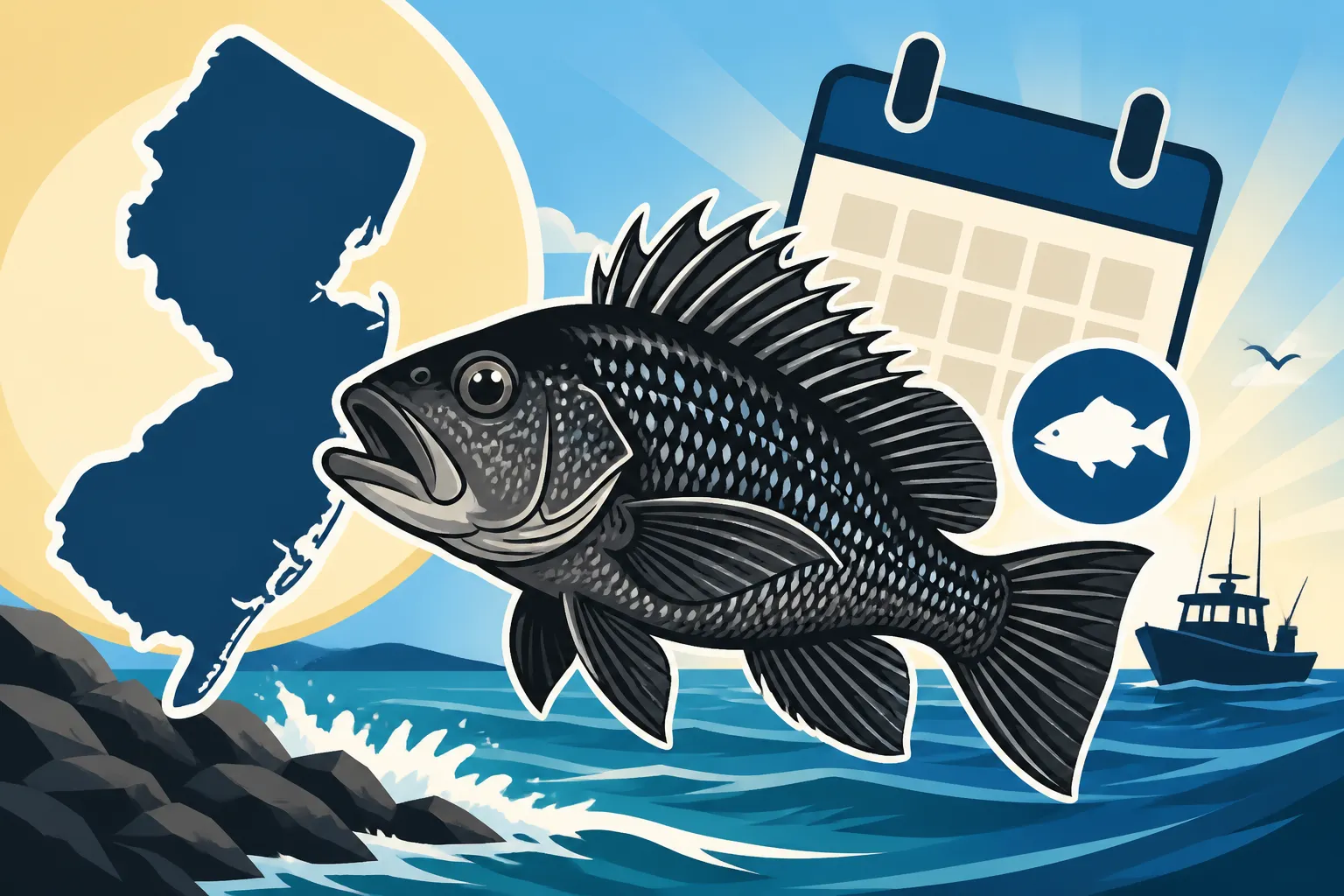
Proper fish identification is critical, especially since other species like tautog or scup might be encountered in the same areas as black sea bass. Black sea bass have a distinct dark, mottled pattern, a dorsal fin with strong spines, and often a prominent hump on their head, particularly in larger males (known as "humpbacks"). Always double-check your catch against the current New Jersey Marine Fish Size Chart 2026 to ensure it meets the minimum length requirements.
For any undersized or non-target fish you catch, practicing ethical catch and release is paramount. Black sea bass, when caught from deeper waters, can suffer from barotrauma (swim bladder expansion) due to the rapid change in pressure. If you notice a fish with bulging eyes, a distended belly, or an everted stomach, using a descending device can greatly increase its survival rate. These devices gently lower the fish back to a depth where it can recompress. If you don't have one, promptly releasing the fish and minimizing its time out of water is the next best option. A quick photo is fine, but don't prolong the release. Having a copy of a fish identification guide (many good ones are available on Amazon) can be a useful tool to quickly identify your catch on the water.
Summary of New Jersey Black Sea Bass Regulations (Example for General Understanding – Check Current Digest for Specifics)
As a reminder, the specific dates, size limits, and bag limits are subject to change annually. This table provides a hypothetical example based on past season structures to illustrate how the regulations might be segmented. Always verify the most current regulations with the NJDEP Fish and Wildlife Digest before you go fishing.
| Season Segment | Hypothetical Dates (Example) | Minimum Size Limit | Daily Bag Limit |
|---|---|---|---|
| Spring | May 15 – June 15 | 12.5 inches | 2 fish |
| Summer Closure | June 16 – July 14 | No fishing allowed | 0 fish |
| Summer/Fall | July 15 – August 31 | 12.5 inches | 7 fish |
| Fall/Winter | September 1 – December 31 | 12.5 inches | 7 fish |
Note: This table is illustrative. The actual 2026 regulations will be set closer to the season based on scientific assessments and federal management guidelines.
Disclaimer
The information provided in this guide is for general informational purposes only and is subject to change. Fishing regulations, including season dates, size limits, and bag limits, are set by the New Jersey Department of Environmental Protection (NJDEP) Division of Fish and Wildlife and federal authorities. These regulations can change frequently. Always consult the most current official New Jersey Fish and Wildlife Digest or the NJDEP Fish and Wildlife website before engaging in any fishing activities to ensure compliance. Failure to comply with regulations can result in significant penalties.