Fishing License Options for Disabled Anglers in New Jersey
For many New Jersey anglers living with a disability, the simple joy of casting a line can feel like navigating a complex maze, not just because of physical challenges, but also the often-confusing bureaucracy of fishing licenses. It's frustrating to just want to enjoy the peace of the water and instead get bogged down in paperwork and requirements. This comprehensive guide is here to untangle those complexities, outlining the specific fishing license options available for disabled anglers in New Jersey, clarifying eligibility, and walking you through the application process so you can get back to what truly matters: fishing.
Understanding the Unique Challenges Disabled Anglers Face
Fishing is more than just a hobby; it's a source of peace, connection to nature, and therapeutic escape for countless people. But for individuals living with disabilities, getting out on the water can present a unique set of hurdles that go far beyond just buying a license. These challenges often start before you even leave home and continue right through the fishing experience itself.
Physical Accessibility Barriers to Fishing
One of the most immediate frustrations for disabled anglers is the sheer lack of physical accessibility at many popular fishing spots. Imagine the anticipation of a perfect day on the water, only to arrive at a beautiful lake or river and find no accessible parking, no paved paths to the shore, or crumbling, unsafe docks. Many piers and jetties, while seemingly public, might have steps, uneven surfaces, or railings that are too high to safely fish over from a wheelchair. Even something as simple as using a public restroom can become a major ordeal if facilities aren't ADA compliant. This isn't just an inconvenience; it can be a complete barrier, turning a hopeful outing into a disheartening retreat. It really puts a damper on the spirit when the physical environment itself becomes an obstacle to enjoying a cherished pastime.
Financial Burdens and Equipment Needs
Beyond physical access, there's often a significant financial burden associated with fishing for disabled individuals. While a standard fishing license cost might seem manageable for some, the added expenses can quickly pile up. Specialized adaptive equipment, for instance, can be quite costly. This might include wheelchair-compatible fishing chairs, rod holders that allow for hands-free casting or reeling, or even modified reels that can be operated with limited dexterity. These aren't luxuries; they're necessities that enable participation. When you factor in transportation costs to accessible locations, potential assistance, and the general rising cost of tackle, the idea of paying full price for a fishing license can feel like another financial strain on an already stretched budget. It's a real Catch-22: you need the equipment to fish, but the equipment is expensive, and then you still need a license.
New Jersey's Special Fishing License for Disabled Residents
Recognizing some of these challenges, New Jersey does offer specific provisions designed to ease the burden for certain disabled residents, particularly concerning fishing licenses. It’s not always as straightforward as it could be, but knowing these options can make a big difference.
Free Fishing Licenses for Totally Disabled Residents
New Jersey extends a very valuable benefit to its residents who are classified as totally disabled and who receive disability benefits from a state or federal agency. For these individuals, the state offers a free fishing license. This isn't just a reduced fee; it's entirely free, removing one significant financial hurdle and acknowledging the ongoing costs associated with living with a total disability. The intent here is to ensure that a love for fishing isn't denied due to financial constraints tied to a disability. This means if you qualify, you don't have to worry about the annual cost of a New Jersey Fishing License Guide for 2026 – a welcome relief for many.
Specific Provisions for Disabled Veterans
New Jersey also has very clear and important provisions for its disabled veterans. If you are a resident of New Jersey and have been honorably discharged from the United States armed forces, and you have a service-connected disability that is certified by the United States Department of Veterans Affairs (VA) as 100% permanent and total, you are eligible for a free fishing license. This is a profound recognition of the sacrifices made by our veterans. It’s a small way the state can say thank you and make it easier for those who have served to find solace and recreation on the water. This particular benefit, the New Jersey Disabled Veteran Fishing License Rules, is one of the most comprehensive and well-defined provisions for disabled anglers in the state. It's important to note that these are distinct categories, and while both lead to a free license, the eligibility criteria differ.
Eligibility Requirements for the Disabled Angler License
Navigating the eligibility requirements can sometimes feel like trying to untangle a particularly stubborn knot in your fishing line. It's crucial to understand the specifics to ensure you qualify and avoid any unnecessary frustration or delays.
Proving New Jersey Residency
First and foremost, to qualify for any special disabled fishing license in New Jersey, you must be a bona fide resident of the state. This means you need to provide adequate proof that New Jersey is your primary and permanent home. The Division of Fish and Wildlife typically requires documents such as a valid New Jersey driver's license, a state-issued non-driver identification card, or other official documents that clearly show your name and a New Jersey address. Utility bills, property tax statements, or voter registration can sometimes be used in conjunction with other IDs. They want to make sure the benefit is going to the people it's intended for – the residents who contribute to and reside in the Garden State. For more details on what constitutes residency, you might want to review the information on Resident vs Nonresident Fishing Rules in New Jersey.
Documentation for Total Disability Status
For the general totally disabled resident license, the key is demonstrating "total disability" as defined by state or federal agencies. This usually means providing official documentation from a recognized entity like the Social Security Administration (SSA) indicating that you are receiving Social Security Disability Income (SSDI) or Supplemental Security Income (SSI) benefits due to a total and permanent disability. Sometimes, documentation from the New Jersey Division of Disability Services or other equivalent state agencies can also be accepted. What they are looking for is clear, irrefutable proof that a qualified governmental body has deemed your disability to be total, and that you are receiving benefits because of it. It’s not enough to just have a disability; you must have this official certification and be receiving benefits.
Verifying 100% Service-Connected Veteran Disability
For disabled veterans, the requirement is very specific: a 100% service-connected permanent and total disability, as certified by the United States Department of Veterans Affairs. This means you'll need to provide an official letter or document directly from the VA stating your disability rating and its permanent and total nature. This isn't just about having a VA disability rating; it must be that specific 100% permanent and total designation. The state uses this specific criterion to ensure the benefit is directed to those veterans with the most severe and enduring service-connected conditions. Without this particular VA documentation, you wouldn't qualify under the disabled veteran category, even if you have other disability ratings. It's a very clear line in the sand.
Here’s a quick overview of the key eligibility points:
| License Type | Eligibility Criteria | Required Documentation (Examples) |
|---|---|---|
| Totally Disabled Resident | – NJ Resident | – NJ Driver's License/State ID |
| – Receiving disability benefits from a state/federal agency | – SSA Award Letter (SSDI/SSI) | |
| – Certified as "totally disabled" | – State Disability Services documentation | |
| 100% Disabled Veteran | – NJ Resident | – NJ Driver's License/State ID |
| – Honorably discharged U.S. Veteran | – VA Benefit Summary Letter (100% P&T service-connected) | |
| – 100% service-connected permanent & total disability (VA certified) | – DD-214 (Proof of Honorable Discharge) |
How to Apply for Your New Jersey Disabled Angler License
Once you've confirmed your eligibility, the next step is actually applying for the license. While the process is generally straightforward, gathering the correct documents and knowing where to submit them is key.
Gathering Necessary Documentation
Before you even think about filling out a form, take the time to gather all the required documentation. For totally disabled residents, this means your proof of New Jersey residency (like a driver's license or state ID) and your official award letter from the Social Security Administration or relevant state agency confirming your total disability and benefits. For disabled veterans, you'll need your proof of New Jersey residency, your DD-214 to prove honorable discharge, and most importantly, that official letter from the VA explicitly stating your 100% service-connected permanent and total disability. Double-check that all documents are current and clearly legible. Having everything organized beforehand will save you a lot of hassle and prevent delays. Imagine getting halfway through the process only to realize you left a crucial document at home – it's a frustration you definitely want to avoid!
Submitting Your Application
Currently, free or reduced-fee licenses for disabled individuals and veterans generally cannot be processed instantly online through the usual portal where you'd buy a regular license. Instead, these special applications often require in-person submission or mailing your documents to the New Jersey Division of Fish and Wildlife.
In-Person: Many anglers find it easiest to go to a regional Division of Fish and Wildlife office. This allows you to present your documents, ask any questions you might have, and often receive your license on the spot, provided all your paperwork is in order. It's reassuring to have someone review everything right then and there.
By Mail: If traveling to an office isn't feasible, you can mail your completed application form along with photocopies (never originals, unless specifically instructed) of your supporting documentation. You'll want to send it to the main licensing unit of the New Jersey Division of Fish and Wildlife. Always use certified mail or a service with tracking to ensure your important documents arrive safely.
The specific application form might be available for download on the NJ Fish and Wildlife website, or you might pick it up at an office. Don't assume the process is the same as how to buy a New Jersey Fishing License Online; these special licenses have a dedicated, more hands-on approach.
Receiving Your License and What to Do Next
Once your application is approved, you'll receive your free fishing license. Remember, just like any other angler, you are legally required to have proof of your license on your person while fishing. This means carrying the physical license or having a digital copy easily accessible on your phone. You can find more information about Carrying Proof of Your New Jersey Fishing License in another one of our guides. Even though the license is free, all other fishing regulations still apply, including bag and size limits, season dates, and specific species rules. It's a privilege, not a pass to ignore conservation efforts. You'll still need to be aware of things like the New Jersey Striped Bass Slot Limit Explained if you're targeting those popular fish.
Important Considerations and Common Questions
Even with a special license, there are always a few extra nuances and questions that tend to pop up. Being prepared for these can make your fishing experience much smoother.
Saltwater Registry and Trout Stamps
A common point of confusion is whether a free fishing license for disabled anglers also covers other necessary permits, like the New Jersey Saltwater Registry or a Trout Stamp. The answer is generally no.
- New Jersey Saltwater Registry: If you plan to fish for finfish in New Jersey's marine and estuarine waters (the ocean, bays, tidal rivers), you are still required to register with the New Jersey Saltwater Recreational Registry Program. The good news is that this registry is free for everyone, regardless of disability status or whether you have a freshwater license. So, while it's an additional step, it won't cost you anything. It’s a separate requirement to track saltwater recreational fishing effort, and your disabled freshwater license doesn't exempt you from it. For a full breakdown, check out our guide on the New Jersey Saltwater Registry Explained.
- New Jersey Trout Stamp: If you intend to fish for trout in any designated trout waters or waters stocked with trout, you will still need to purchase a New Jersey Trout Stamp. Unlike the saltwater registry, the trout stamp is not free. Your disabled fishing license only covers the general freshwater license fee; it does not cover the specialized trout stamp. This is an important distinction to remember, as fishing for trout without the stamp, even with a valid free license, can result in penalties. You can learn more about New Jersey Trout Stamp Requirements Explained to make sure you're covered.
Reciprocity with Neighboring States
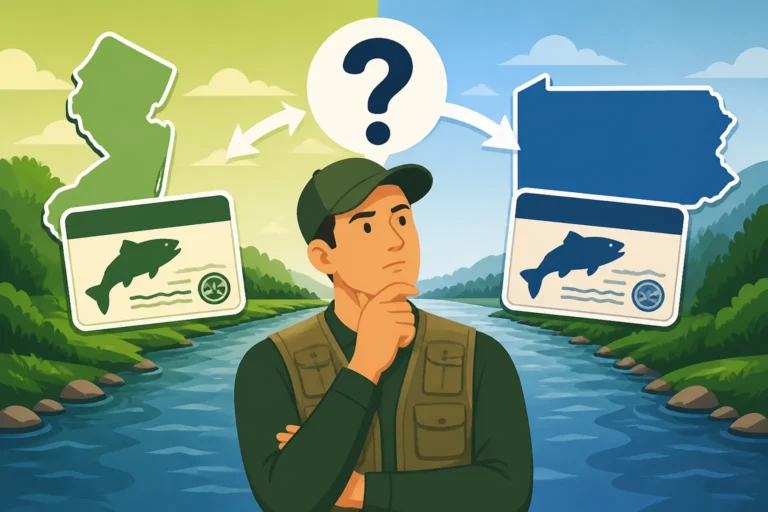
Another frequent question concerns whether a New Jersey disabled fishing license is valid in neighboring states like Pennsylvania or New York, especially when fishing shared waters like the Delaware River. Unfortunately, fishing licenses, including those for disabled anglers, are almost exclusively state-specific. Your New Jersey license is valid only for waters within New Jersey's jurisdiction. If you plan to fish in shared waters or cross into another state's territory, you will typically need to acquire the appropriate license for that state. Even if New Jersey has reciprocal agreements for general licenses on certain border waters, it's highly unlikely that a special disabled license would automatically transfer. Always check the regulations of the state you plan to visit, even for a short fishing trip.
Penalties for Non-Compliance
It might seem unfair to face penalties when you've gone through the effort of getting a special license, but it's crucial to understand that all anglers, including those with free or special licenses, are subject to the same enforcement. Fishing without the proper license (or trout stamp, if applicable), or failing to comply with size and bag limits, can result in fines. What Happens If You Get Caught Fishing Without a License in New Jersey? is a question you don't want to learn the answer to the hard way. Conservation Police Officers regularly conduct checks, and while they are generally understanding, ignorance of the law is not an excuse. Always have your license accessible, know the rules for the species you're targeting, and double-check any specific regulations for the body of water you're fishing.
Beyond the License: Making Fishing Accessible for All
While securing the right license is a critical first step, truly making fishing accessible for disabled anglers goes much further. It involves advocating for better infrastructure and exploring adaptive tools that can enhance the fishing experience.
Accessible Fishing Locations and Facilities
The New Jersey Division of Fish and Wildlife, along with state and local parks, has made strides in creating more accessible fishing opportunities. These often include fishing piers with accessible ramps, paved paths, and railings designed to be usable from a seated position. Popular spots like Island Beach State Park, while known for surf fishing, also have areas with improved access, though it’s always best to check specific conditions. Many state parks now highlight their ADA-compliant facilities. However, there's always room for improvement. When planning a trip, always call ahead to the specific park or facility to inquire about current accessibility conditions. Websites can sometimes be outdated, and a quick phone call can save you a lot of disappointment. Look for information on places like New Jersey State Park Fishing Permit Fees which may also detail accessibility features.
Adaptive Fishing Gear and Equipment
The market for adaptive fishing gear has grown significantly, offering innovative solutions to common challenges. These products are designed to make fishing more comfortable and effective for anglers with various disabilities.
- Hands-Free Rod Holders: These can mount to wheelchairs, benches, or even be worn, allowing anglers with limited arm strength or dexterity to cast, hold a rod, and even fight a fish without constant manual support. Some are spring-loaded to assist with casting.
- Electric Reels: For those with limited hand or arm mobility, electric reels can take the strain out of reeling in a heavy catch. While often expensive, they can be a game-changer for serious anglers. You can often find a good selection of these, along with specialized rod holders and other accessories, on platforms like Amazon, making it easier to research and compare options from the comfort of your home.
- Modified Grips and Handles: Many companies offer ergonomic grips, larger handles, or even universal cuffs that can attach to rods and reels, providing a better hold for those with conditions like arthritis or nerve damage. Even simple modifications, like adding tennis racket grip tape, can make a difference.
- Specialized Casting Aids: Devices that assist with the casting motion or even launch bait can open up new possibilities for anglers who struggle with traditional casting techniques.
These advancements mean that more people can enjoy the sport. Even a trip to a local tackle shop or a browse on Amazon can reveal a wealth of clever tools that might just be the missing piece to your fishing puzzle. Don't be afraid to experiment and find what works best for you!
The Importance of Community and Support
Beyond gear and accessible spots, the most invaluable resource for disabled anglers is often community. Connecting with other disabled anglers, local fishing clubs, or organizations dedicated to adaptive outdoor recreation can provide a wealth of information, support, and companionship. These communities often share tips on accessible locations, recommend specific adaptive gear, and organize group outings that foster a sense of belonging. Sharing frustrations and successes with others who truly understand the unique journey of a disabled angler can be incredibly empowering. Organizations like "Physically Challenged Anglers of America" or local New Jersey fishing groups can be fantastic resources. Never underestimate the power of shared experience and a friendly face on the water.
Disclaimer
Please remember that fishing regulations, license requirements, and eligibility criteria are subject to change. While we strive to provide the most accurate and up-to-date information, it is always your responsibility to verify the current rules and requirements with the New Jersey Division of Fish and Wildlife or the appropriate authorities before heading out to fish. This guide is for informational purposes only and should not be considered legal advice.