What Is the New Jersey Trout State Record?
There's a special kind of thrill that comes with reeling in a beautiful trout in New Jersey, isn't there? Whether it's the vibrant colors of a rainbow or the elusive nature of a brown, these fish capture our imagination. But every now and then, you hear whispers of an absolutely monster trout, a true leviathan that makes you wonder: what's the biggest one ever caught around here? If you've ever dreamt of landing a record-breaker or just curious about the angling legends of our state, this guide is going to dive deep into New Jersey's trout state records, helping you understand the history, the fish, and what it takes to join that elite club.
Understanding New Jersey's Trout Species and Their Records
New Jersey's waters are home to a few different species of trout, each with its own unique charm, fight, and, of course, state record. It's not just about size; it's about the challenge each species presents. Knowing what you're targeting is the first step in any angling adventure, especially when you're aiming for something truly extraordinary.
The Different Trout Species in New Jersey
When we talk about trout in New Jersey, we're primarily looking at three main species that capture the hearts of anglers: Rainbow Trout, Brown Trout, and our native Brook Trout. Each one is distinct, both in appearance and typical habitat.
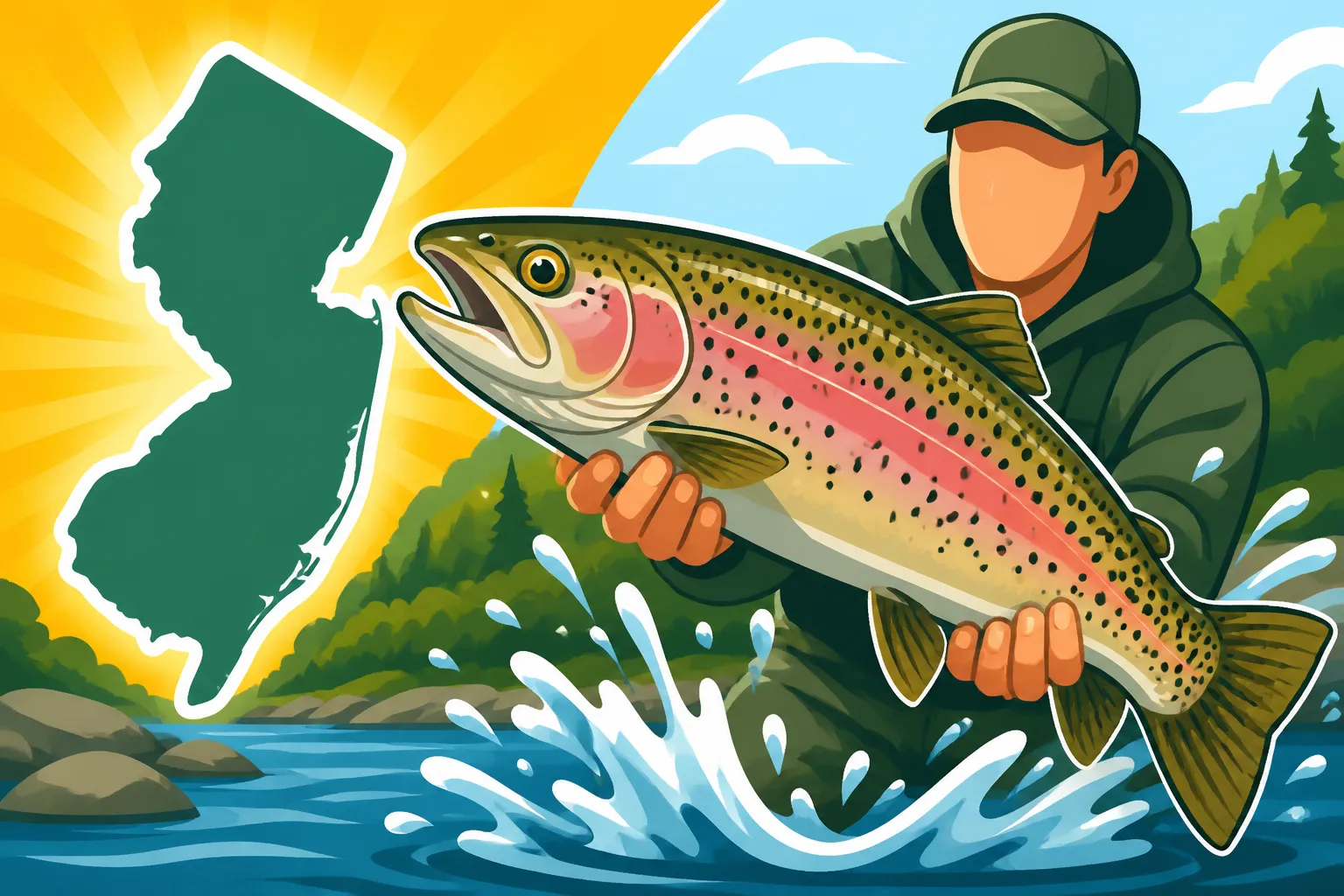
Rainbow Trout are probably the most recognizable, with that distinctive iridescent stripe running along their sides. They're heavily stocked across the state's lakes, ponds, and rivers, making them a common and exciting catch for many. They're known for their acrobatic jumps and spirited fights, especially when hooked in colder waters. While many stocked rainbows are pan-sized, given enough time and a rich food source, they can grow to impressive dimensions, becoming serious contenders for a record book. They thrive in many of our public waters, from the Musconetcong River to larger impoundments. You can learn more about these different species in our guide on New Jersey Rainbow Trout vs Brown Trout vs Brook Trout.
Brown Trout, on the other hand, are often considered a more elusive and intelligent species. With their golden-brown flanks adorned with red and black spots, they blend perfectly into rocky stream beds and often hold in deeper, more complex cover. While they're also stocked, they can be much harder to tempt, demanding a more subtle approach and often larger offerings. Brown trout have a reputation for growing into true lunkers, especially in waters with good forage fish populations. They're often the species that anglers dedicate years to chasing, hoping to best their personal record or perhaps even the state record.
Then we have the Brook Trout, New Jersey's only native trout species. These fish are absolute gems, with their intricate vermiculation patterns, red spots ringed with blue, and pristine white-tipped fins. Brook trout prefer cold, clean, highly oxygenated water, typically found in the headwaters of our mountain streams and smaller, undisturbed brooks. While they don't usually grow as large as rainbows or browns, a trophy brook trout is a truly special catch, representing the health and wildness of our most pristine waterways. Catching a large brook trout often means venturing into more remote areas, far from the crowds.
Current New Jersey State Records for Trout
So, you want to know what the benchmark is? What kind of fish are we talking about when we discuss state records? These aren't just big fish; they are truly exceptional specimens that represent a lifetime of growth and a monumental catch for the lucky angler. Each of the primary trout species has its own individual state record, a testament to its potential size in New Jersey waters.
Historically, the state records for trout in New Jersey have been held by fish that are not only heavy but also possess impressive length and girth, clearly distinguishing them from an average catch. For example, the state record Rainbow Trout is an absolute behemoth, weighing in at an incredible amount. Similarly, the Brown Trout record is held by a fish that tips the scales with a substantial weight, reflecting its predatory nature and longevity in our bigger waters. Even the Brook Trout, though typically smaller, has a record that represents a truly massive specimen for its species in New Jersey, far exceeding what most anglers ever encounter.
It's important to remember that these records are the culmination of perfect conditions – the right fish in the right place at the right time, combined with the angler's skill and a bit of luck. These aren't fish you're going to pull out of a small local pond every weekend. They often come from our premier trophy trout waters, places specifically managed for larger fish, or from incredibly fertile bodies of water where trout have an abundance of food and ideal growing conditions.
To give you a clearer picture, here's a general overview of the species and their record-holding nature. Please keep in mind that exact weights can change and are always best verified with the official New Jersey Department of Environmental Protection (NJDEP) Fish and Wildlife records, as I cannot provide real-time updates or specific numbers.
| Trout Species | General Size of Record Fish | Typical Habitat |
|---|---|---|
| Rainbow Trout | Exceptionally heavy and long; well into double-digit pounds | Rivers, streams, large lakes, reservoirs |
| Brown Trout | Significant weight, often a very long and thick fish; double-digit pounds | Rivers, streams, larger lakes, deeper pools |
| Brook Trout | Very large for its species, impressive length and girth; several pounds | Cold, clean headwater streams, pristine brooks |
These record-holders represent fish that have evaded countless anglers and survived many seasons, growing to extraordinary proportions.
How Records Are Verified and Recognized
Catching what you think might be a state record is only the first step; the verification process is rigorous and designed to ensure that every record is legitimate. This isn't just a casual weigh-in at the bait shop; it's a formal procedure that requires precision and adherence to strict rules set by the New Jersey Department of Environmental Protection (NJDEP) Fish and Wildlife.
First and foremost, any potential record fish must be weighed on a certified scale. This isn't your bathroom scale or the one at the grocery store. It needs to be a scale that has been officially calibrated and sealed by the Office of Weights and Measures. Often, bait and tackle shops, marinas, or even some post offices have these certified scales. The weight must be verified by at least one witness, and ideally, more than one. These witnesses will need to sign an affidavit confirming the details of the catch and the weight.
Beyond just the weight, the species identification is absolutely crucial. You might think you have a brown trout, only for it to be identified as a hybrid or another species, which wouldn't qualify for the record you're aiming for. Clear, high-quality photographs are required, showing the entire fish, its length, and any distinguishing features. These photos help the experts at NJ Fish and Wildlife verify the species.
Once all the necessary information—weight, length, girth, photos, witness statements, and details about the catch (date, time, location, tackle used)—is gathered, you'll need to submit an official application to the NJDEP Fish and Wildlife. They will review everything meticulously. This process ensures the integrity of the state records and prevents any disputes. So, if you ever find yourself with a potential record-breaker on the line, remember to have a plan in place. Knowing these rules beforehand is crucial, as often the excitement of the moment can lead to mistakes that invalidate a potential claim. New Jersey Conservation Police and License Checks can sometimes be involved in verifying large or unusual catches, highlighting the official nature of the process.
Chasing a Trophy Trout in New Jersey
The dream of catching a trophy trout, let alone a state record, drives many anglers to spend countless hours on the water. It's not just about luck; it's about understanding the fish, their habitat, and employing the right strategies. While a record-breaker is always a long shot, increasing your odds involves smart planning and persistent effort.
Key Factors for Finding Record-Breaking Trout
Finding truly gigantic trout in New Jersey is an endeavor that combines local knowledge, an understanding of trout biology, and often, a willingness to explore. These fish don't just appear anywhere; they come from specific environments that support their growth to immense sizes.
One of the most critical factors is location. Larger, deeper reservoirs and lakes, particularly those designated as "Trophy Trout Lakes," are prime candidates. Places like New Jersey's Round Valley Reservoir Fishing Guide are famous for producing massive trout, especially lake trout which can grow to impressive sizes, but also big browns and rainbows that thrive on a rich diet of baitfish. These larger bodies of water often have ample deep, cool water throughout the summer, providing the ideal conditions for trout to grow old and large. Rivers with strong, consistent flows and abundant food sources, especially those that aren't overfished, can also hold behemoths. It's often the less-pressured stretches of water, or those with significant natural structure like deep pools, undercut banks, or submerged timber, that provide sanctuary for these wise old fish.
Conditions play a huge role. Big trout are often most active during periods of cooler water temperature, typically in spring and fall, but also during low-light conditions like dawn, dusk, or even at night during warmer months. During the peak of summer, they'll retreat to the deepest, coolest parts of the water column. Understanding current weather patterns and how they affect water temperature and clarity is key. A rising water temperature can shut down a bite, while a sudden drop in barometric pressure might spark a feeding frenzy.
Finally, a rich food source is paramount. A trout cannot grow to record size without an abundant and consistent supply of high-quality food. In larger lakes and reservoirs, this often means a healthy population of baitfish like alewives, shiners, or even smaller panfish. In rivers, it might be crayfish, large aquatic insects, or even mice and small amphibians. Anglers targeting trophy trout often focus their efforts on imitating these larger food items, knowing that a truly big fish isn't going to expend energy chasing tiny morsels. Understanding the What Do Stocked Trout Eat? can give you clues about their dietary preferences.
Essential Gear and Techniques for Trophy Hunting
When you're chasing that fish of a lifetime, your standard ultralight trout setup might not cut it. Trophy trout demand more robust gear and often more specialized techniques. This isn't just about hauling in a fish; it's about having the right tools to present your offering effectively and then handle a powerful, potentially record-breaking fight.
For starters, you'll want a rod with enough backbone to cast larger baits or lures and to control a powerful fish. A medium to medium-heavy spinning rod, or even a baitcasting setup, depending on your preference, will give you the leverage you need. Pair that with a reliable reel spooled with strong, abrasion-resistant line—think 8-15 lb test monofilament or fluorocarbon, or even heavier braided line with a fluorocarbon leader for stealth. You don't want to lose that fish because your line snapped on a rock or a sudden run. You can find a fantastic selection of these heavier-duty rods, reels, and specialized lines on Amazon, often with detailed reviews to help you choose the perfect setup for trophy trout.
When it comes to bait and lures, you need to think big. While smaller baits might catch numbers, a truly massive trout is looking for a substantial meal. Live bait like large shiners, suckers, or even small stocked trout (if legal and appropriate for the fishery) can be incredibly effective. For lures, consider large spoons, swimbaits that mimic the local forage, or crankbaits that dive to the depths where these giants lurk. PowerBait, in larger quantities, can also tempt stocked trophy fish. The trick is to match the hatch, but for the biggest hatch. Also, consider the water you're fishing – fly fishing for trophy trout in smaller streams might mean larger streamers, while in stillwaters, it could involve big articulated flies. For techniques, learn How to Drift Fish for Fluke (while not trout, the principles of presenting bait to big fish are similar) or try slow-trolling larger offerings in deep lakes.
Beyond the specific gear, fishing smart is paramount. This means more than just casting and reeling. It's about reading the water for subtle changes in depth, current, or structure that might indicate where a big trout is holding. It's about presenting your bait naturally and stealthily. Big trout are often solitary and wary, so minimizing your disturbance and making accurate casts are key. Patience is also a technique; you might cast to the same spot dozens of times before getting a strike from a cautious leviathan. Having a good landing net, one large enough to handle a record-sized fish without stressing it or risking it getting away at the boat, is also an absolute must. Many serious anglers invest in larger rubberized nets, easily found on Amazon, which are gentler on the fish and less likely to tangle hooks.
Patience, Persistence, and the Thrill of the Hunt
Let's be real: breaking a state record for trout in New Jersey isn't something that happens by accident, or even by just going out on a whim. It's often the culmination of years, sometimes decades, of dedicated effort, learning, and an unwavering passion for the sport. It's a journey filled with early mornings, late nights, countless casts, and certainly, a fair share of frustration.
Imagine the angler who spends every available weekend targeting a particular stretch of the Musconetcong River known for its elusive brown trout, or the individual who patiently trolls the deep waters of Round Valley Reservoir season after season, hoping to hook into that legendary lunker. It's not just about the moment the fish bites; it's about all the research, the trial and error, the fine-tuning of techniques, and the countless hours spent on the water when nothing seems to be biting. These are the anglers who pore over New Jersey Fishing Season Dates and Closures and weather charts, analyzing every detail to find that perfect window of opportunity.
The pursuit itself is a significant part of the reward. The quiet anticipation as you watch your line, the sudden jolt of a strike that might be the one, the adrenaline rush of a powerful fight—these moments are what keep us coming back. Even if you never quite break the state record, the personal bests, the challenging fights, and the sheer beauty of the fish you encounter along the way are unforgettable. It’s about the stories you collect, the lessons you learn, and the deep connection you forge with New Jersey's natural environment.
Sometimes, the "frustrations" of fishing — the days you get skunked, the gear that breaks, the weather that turns — become part of the story, making the eventual success, big or small, even sweeter. The equipment you rely on, from your waders to your tackle box, becomes a trusted companion. Investing in quality gear, perhaps even from a trusted online source like Amazon, becomes less about a purchase and more about preparing for those moments when persistence finally pays off.
The Legacy of New Jersey's Record Trout Anglers
Every state record fish represents not just a phenomenal catch, but also a piece of angling history and a tribute to the waters it came from. These records inspire future generations and highlight the importance of careful stewardship of our natural resources.
Stories Behind Past Record Catches
While the exact details of every record catch fade with time, the legacy of those incredible fish and the anglers who caught them lives on. Each record trout in New Jersey likely has a compelling story behind it – a tale of an angler's dedication, a surprising strike, or a moment of pure disbelief. These aren't just weights on a ledger; they are moments etched into the state's fishing folklore.
Think about the conditions that must have aligned for these fish to reach such monumental sizes. Perhaps it was a particularly mild winter that allowed for extended growth, or an explosion in a specific forage species that provided an abundance of food. The anglers themselves often represent decades of experience, a deep understanding of the local waters, and a keen eye for subtle signs that others might miss. Their stories serve as an inspiration, reminding us that with enough time, effort, and a little bit of luck, anyone can have that once-in-a-lifetime encounter. They also emphasize the importance of fishing responsibly and appreciating the beauty of these magnificent creatures.
Conservation and the Future of Trout Fishing
The existence of state record trout isn't just a point of pride; it's also a strong indicator of successful conservation efforts and healthy aquatic ecosystems in New Jersey. Without sustained efforts to protect and enhance our trout habitats, such large fish would simply not be possible.
The NJDEP Fish and Wildlife plays a crucial role through its extensive trout stocking programs. These programs ensure that a consistent population of trout is available for anglers, and a percentage of these fish, given time and the right conditions, will grow into impressive specimens. Our guide on How Many Trout Are Stocked Each Year in New Jersey? delves into the incredible scale of these efforts. Beyond stocking, habitat restoration projects, water quality monitoring, and adherence to New Jersey Freshwater Fishing Regulations Every Angler Should Know all contribute to creating environments where trout can thrive and reach their full potential.
Catch-and-release practices, particularly for larger, potentially breeding fish, are also vital for maintaining healthy populations. While it’s tempting to keep a monster trout, releasing a truly large fish allows it to continue its role in the ecosystem, potentially spawning and contributing its strong genetics to future generations. This responsible angling mindset, coupled with the efforts of conservation organizations and state agencies, ensures that the dream of catching a trophy trout remains alive for many years to come.
How to Properly Document and Submit a Potential Record
Okay, so you've done it. Against all odds, you've landed a fish that looks like it could challenge the state record. What now? The moments immediately following such a catch are critical, and knowing exactly what steps to take can mean the difference between having your name in the record books and just having a great fish story.
The first, and most crucial, step is to keep the fish alive if possible, or preserve it carefully on ice. While some records are catch-and-release, most state records, especially for weight, require the fish to be weighed on a certified scale. If the fish is kept, it needs to be protected from drying out or losing weight.
Next, you need to locate a certified scale. This usually means heading directly to a local bait and tackle shop, marina, or other establishment that has a scale officially approved for trade by the Office of Weights and Measures. Have witnesses present, preferably more than one, to observe the weighing. These witnesses will need to confirm the weight and potentially sign off on an affidavit.
Document everything. This includes taking clear, high-quality photographs of the fish from multiple angles, especially one showing its full length and another close-up for species identification. Measure its length and girth accurately, noting the measurements. Gather all the details of the catch: the exact date and time, the specific location (as precise as you can be without revealing a secret spot!), the type of tackle used (rod, reel, line, bait/lure), and any other relevant information.
Finally, you'll need to contact the New Jersey Department of Environmental Protection (NJDEP) Fish and Wildlife to obtain their official state record application form. Fill out the form completely and submit it with all your documentation, including photos, witness statements, and any other required information. The department will review your submission and, if everything is in order, will officially recognize your catch. This process can take some time, but the reward of seeing your name in the record books for New Jersey is undoubtedly worth the effort. Knowing these procedures beforehand is truly invaluable, so you're not scrambling in the excitement of a potential record-breaking catch.
Disclaimer
This article is for general informational purposes only and does not constitute professional advice. Laws, prices and regulations vary by location and change over time. Consult a qualified professional for guidance on your specific situation.