What Is the Difference Between Fluke and Flounder?
If you've ever stood on a New Jersey dock, pier, or boat, heard two seasoned anglers passionately debating "fluke" versus "flounder," and walked away feeling more confused than enlightened, you're absolutely not alone. This is a common point of contention and misunderstanding for many anglers, whether you're a beginner just getting your feet wet or someone who's spent years on our beautiful coastal waters. This guide aims to demystify the names, clarify the key differences, and explain why knowing them matters for a successful and legal fishing trip in the Garden State.
The Enduring Confusion Between Fluke and Flounder in New Jersey
It's easy to get these terms mixed up, and honestly, the local lingo doesn't always help. You'll hear people use "flounder" as a catch-all term, and then suddenly switch to "fluke" when they're talking about a specific fish they caught in the summer. It's enough to make your head spin, especially when you're trying to make sense of regulations or even just understand what kind of fish your buddy is raving about. The truth is, there's a good reason for the confusion, but also a clear distinction that once you grasp it, will make your New Jersey fishing adventures much clearer.
Why the Names Get Mixed Up
The primary reason for this linguistic tangle is that "flounder" is actually a broad family of flatfish, a bit like how "bass" can refer to largemouth, smallmouth, or striped bass. Within this larger flounder family, there are several distinct species, and "fluke" is simply the common name given to one of the most popular and sought-after members in New Jersey: the Summer Flounder. So, all fluke are flounder, but not all flounder are fluke. It's a classic case of a square being a rectangle, but a rectangle not always being a square.
Adding to the confusion is the fact that different regions, and even different generations of anglers, might have their own preferred terms. Some older folks might refer to any flatfish they catch as "flounder," regardless of the species. Others, especially those focused on recreational fishing in the warmer months, will almost exclusively use "fluke" because the Summer Flounder is such a predominant target. This regional variation, combined with a lack of precise biological education for many recreational anglers, creates a linguistic minefield where a simple fish name can cause a spirited, if unnecessary, debate.
Common Misconceptions and Local Lingo
One of the biggest misconceptions is that "flounder" and "fluke" are entirely different categories of fish, rather than one being a subset of the other. Many anglers are under the impression that if it's a "flounder," it must be the Winter Flounder (also known as blackback flounder), and if it's a "fluke," it's something entirely separate. While these two species are indeed very different in appearance and behavior, they both belong to the flatfish order. The common usage often implies an either/or scenario, when in reality, it's a hierarchy.
Local tackle shops and bait vendors, while usually very knowledgeable, sometimes adopt the common local lingo for simplicity. You might walk into a shop and ask for bait for "flounder," and they might assume you mean Winter Flounder if it's early spring, or "fluke" if it's prime summer season. It's a pragmatic approach to communication, but it perpetuates the idea that these are completely separate entities rather than distinct species within the same broader family. Understanding that you're seeking a specific type of flounder – the Summer Flounder, colloquially known as fluke – can help you communicate more clearly and prepare more effectively.
Decoding the Differences: Fluke (Summer Flounder) vs. Other New Jersey Flounders
Once you know what to look for, distinguishing a fluke from other flounders becomes surprisingly straightforward. It's all about paying attention to a few key physical characteristics and understanding their preferred habitats. This knowledge isn't just for showing off; it's essential for legal compliance and successful angling.
Key Identifying Features of a Fluke (Summer Flounder)
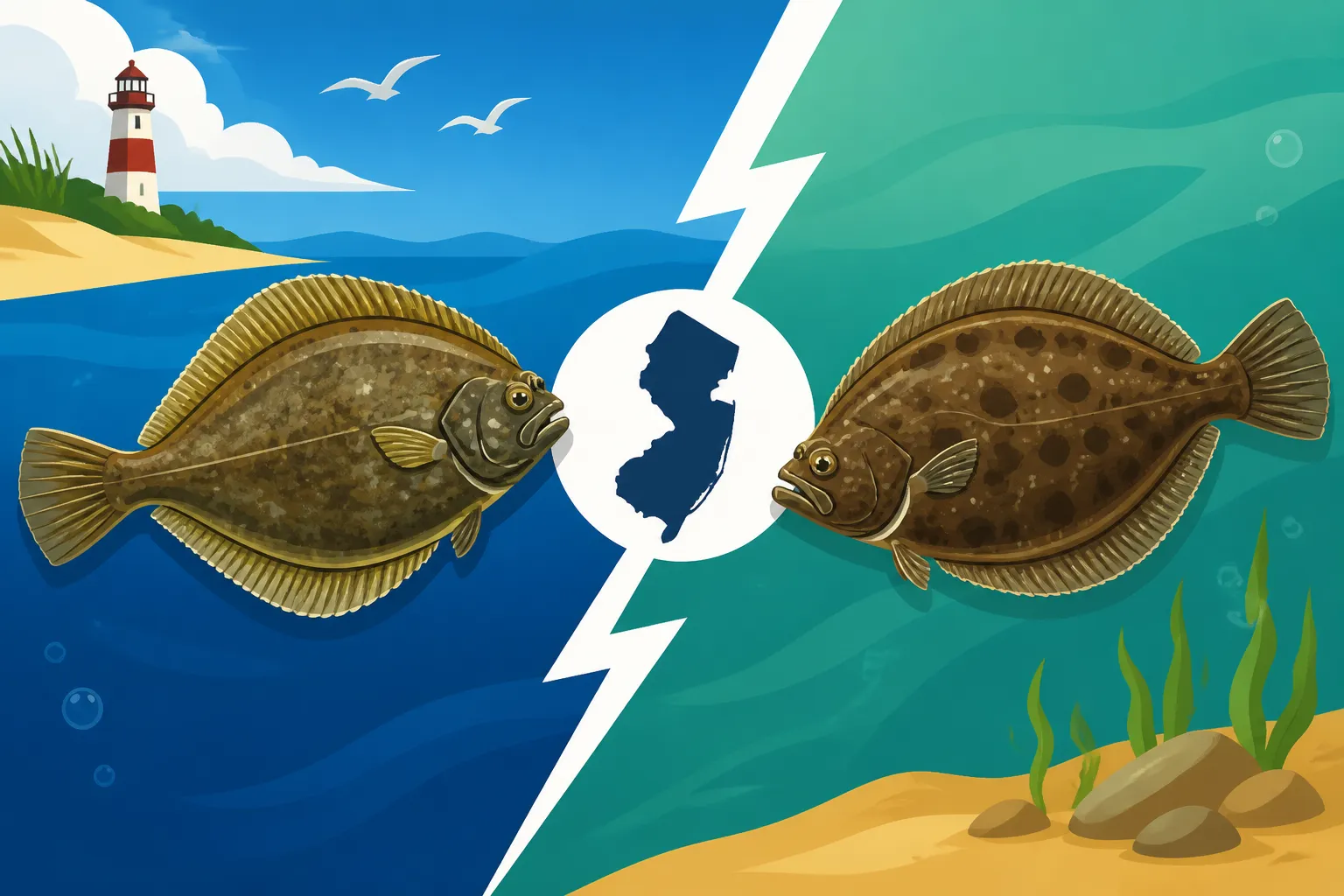
Let's start with the star of the summer show: the fluke, or Summer Flounder. The absolute easiest way to identify a fluke is by its eyes. If you hold the fish with its mouth facing upward, a fluke will always have both of its eyes on the left side of its head. This is a dead giveaway, and probably the first thing any seasoned angler will check when you pull a flatfish into the boat. This left-eyed orientation is a crucial diagnostic feature, making identification quick and accurate.
Next, take a look at its mouth. Fluke are predatory fish, and their mouths reflect that. They have a large mouth with prominent, sharp teeth—perfect for ambushing smaller fish and squid. Their body shape is generally more elongated and diamond-like compared to other flounders, giving them a sleek profile built for darting after prey. In terms of coloration, they are typically darker on their eyed side (often a mottled brown, gray, or olive green) with a lighter underside. Crucially, they usually possess five distinct, dark spots arranged in an arc on their eyed side, although the prominence of these spots can vary. These spots, while not always perfectly clear, are another helpful clue when trying to identify your catch. If you need a comprehensive visual guide, checking out a resource like New Jersey Fluke Identification Guide can be incredibly helpful.
Characteristics of Other New Jersey Flounder Species (Winter, Windowpane, etc.)
Now, let's look at the other major player in the New Jersey flounder scene: the Winter Flounder, often simply called "flounder" by many. The most obvious difference, the inverse of the fluke, is its eye placement: a Winter Flounder will have both of its eyes on the right side of its head when held with its mouth facing upward. This single characteristic immediately tells you it's not a fluke.
Beyond the eyes, the Winter Flounder has a much smaller mouth than a fluke, with smaller, less pronounced teeth. This is because they are primarily bottom feeders, sucking up worms, clams, and small crustaceans rather than actively hunting fish. Their body is also generally more rounded or oval-shaped, lacking the elongated diamond profile of a fluke. Their coloration is usually a more uniform dark brown or olive, without the distinct spots found on a fluke. They are known for their firm, white flesh, and can be quite a treat when fresh. While they don't grow as large as some fluke, a respectable Winter Flounder is still a fantastic catch, with typical sizes discussed in articles like Winter Flounder Average Size in New Jersey Waters.
New Jersey waters also host other less common flatfish, like the Windowpane Flounder. As its name suggests, the Windowpane Flounder is remarkably thin and almost translucent, allowing light to pass through its body. It also has its eyes on the right side, a small mouth, and very large, rounded fins. While fascinating to catch, they're not typically targeted for table fare due to their thinness. Other species like the Hogchoker, though technically a sole, are also flatfish found in our estuaries, further illustrating the diversity of this family, but they are easily distinguishable by their unique, almost disc-like shape and small size.
| Feature | Fluke (Summer Flounder) | Winter Flounder |
|---|---|---|
| Eye Placement | Left side of head (when mouth faces up) | Right side of head (when mouth faces up) |
| Mouth Size | Large, with prominent, sharp teeth | Small, less pronounced teeth |
| Body Shape | More elongated, diamond-like | More rounded or oval-shaped |
| Coloration | Mottled brown/gray/olive, often with 5 distinct spots | Uniform dark brown or olive, no distinct spots |
| Primary Diet | Ambush predator (fish, squid, crabs) | Bottom feeder (worms, clams, crustaceans) |
| Preferred Water | Warmer ocean waters, bays, inlets, near structure | Colder, shallower bays and estuaries, muddy bottoms |
| Season | Primarily summer and early fall | Primarily late winter and spring |
Behavioral and Habitat Differences
Knowing the physical distinctions is one thing, but understanding their behavior and where they prefer to live is another crucial piece of the puzzle. This helps you target the right fish with the right techniques. Fluke, being aggressive predators, often position themselves near structure – think oyster beds, channel edges, wrecks, reefs, and inlet jetties – where they can ambush baitfish and squid. They prefer warmer water and are highly migratory, moving into New Jersey's bays and nearshore ocean waters in late spring and summer. This is why you'll hear about the "fluke bite" heating up when the water temperatures rise. You can often find them by drifting with the current, presenting bait or lures like bucktails or artificial baits you might purchase from online retailers like Amazon, directly into their strike zone.
Winter Flounder, on the other hand, are true bottom dwellers. They're not chasing down active prey; instead, they "graze" the bottom for worms, small clams, and crabs. They thrive in colder water and are typically found in shallower, muddier bays and estuaries during the late winter and spring months. As the water warms in summer, they tend to move offshore to deeper, cooler waters or become less active. When fishing for Winter Flounder, anglers often anchor up and chum, presenting natural baits like bloodworms or clam strips directly on the bottom. Understanding these seasonal preferences, as detailed in resources like New Jersey Fluke Season Start Date and winter flounder fishing in New Jersey, is key to targeting your desired species.
Practical Implications for Anglers: Why This Matters
Beyond just satisfying your curiosity, knowing the difference between a fluke and other flounders has very real, very practical implications for your fishing endeavors in New Jersey. It directly impacts whether you're fishing legally, efficiently, and with the best chances of success.
Regulatory Distinctions and Conservation
This is perhaps the most critical reason to understand the difference. New Jersey's fishing regulations, set by the Division of Fish and Wildlife, often have different size limits, bag limits, and open seasons for Summer Flounder (fluke) compared to Winter Flounder. For instance, the minimum size limit for a fluke can be significantly different from that for a Winter Flounder, and their open seasons rarely overlap completely. Getting this wrong can lead to fines, confiscation of your catch, and a generally unpleasant encounter with conservation police.
These regulations are put in place for conservation purposes, ensuring the sustainability of fish populations. By correctly identifying your catch, you're not only staying within the law but also contributing to the responsible management of our marine resources. It's vital to consult the most current New Jersey Fish and Wildlife Digest to ensure you're aware of the specific rules for each species. For a deeper dive into these important regulations, articles like New Jersey Fluke Size and Bag Limits Explained and How Bag and Size Limits Work in New Jersey are invaluable.
Tailoring Your Fishing Approach
Knowing what kind of "flounder" you're after will dictate your entire fishing strategy, from your chosen location to your tackle box contents. If you're targeting fluke, you'll likely head to bays, inlets, or ocean reefs in the warmer months, armed with bucktails, Gulp! artificial baits, or live killifish. You'll employ techniques like drifting, jigging, or slow trolling. Many anglers find specific fluke rigs and jigs easily on platforms like Amazon, ensuring they have the right presentation for these aggressive feeders.
If Winter Flounder are your quarry, you'll focus on colder, shallower bay waters, especially in early spring. Your gear will shift to lighter tackle, smaller hooks, and natural baits like bloodworms or clam strips, fished on the bottom with a spreader rig. You might even invest in a good chum pot. The difference in feeding habits and preferred habitats means that a "one-size-fits-all" approach to flounder fishing simply won't yield consistent results. To truly maximize your chances, familiarize yourself with methods like those described in How to Fish for Fluke in New Jersey and adapt your approach accordingly.
Culinary Considerations
While both fluke and Winter Flounder are delicious whitefish, some anglers have strong preferences for one over the other. Fluke generally has a delicate, flaky, and slightly sweet flavor, making it a highly prized table fish often featured in fine dining. Its larger size also means more fillets, which is always a bonus!
Winter Flounder also offers fantastic fillets, often described as having a slightly firmer texture and a more pronounced "flounder" taste. They are excellent fried, baked, or broiled. Ultimately, the best way to determine your preference is to catch and try both! Either way, understanding which species you've landed means you can anticipate its culinary profile and plan your meal accordingly, perhaps even researching recipes for your specific catch online.
Disclaimer
This article is for general informational purposes only and does not constitute professional advice. Laws, prices and regulations vary by location and change over time. Consult a qualified professional for guidance on your specific situation.