How Do You Tell a Largemouth From a Smallmouth Bass?
For many New Jersey anglers, there's a moment of hesitation when you pull a bass from the water: "Is that a largemouth or a smallmouth?" It's a common conundrum, especially for those new to bass fishing or exploring different waters. Knowing the difference isn't just about identifying your catch; it's crucial for understanding regulations, tailoring your techniques, and, let's be honest, earning those bragging rights! This guide will break down the distinct features that make each of New Jersey's popular bass species unique, helping you confidently identify your next catch.
The Tell-Tale Visual Differences: What to Look For
When a bass is flopping in your net, there are a few key physical characteristics you can quickly scan for to distinguish between a largemouth and a smallmouth. These aren't subtle hints; once you know what to look for, they become incredibly obvious, even at a glance. It's like telling apart a golden retriever from a Labrador – similar, but distinct once you know the markers.
The Mouth and Jawline
This is often the first and most definitive clue, and it's where the largemouth bass gets its name. Grab the fish by the lower jaw (gently, of course, and wet your hands!). Now, observe how far back the jaw extends.
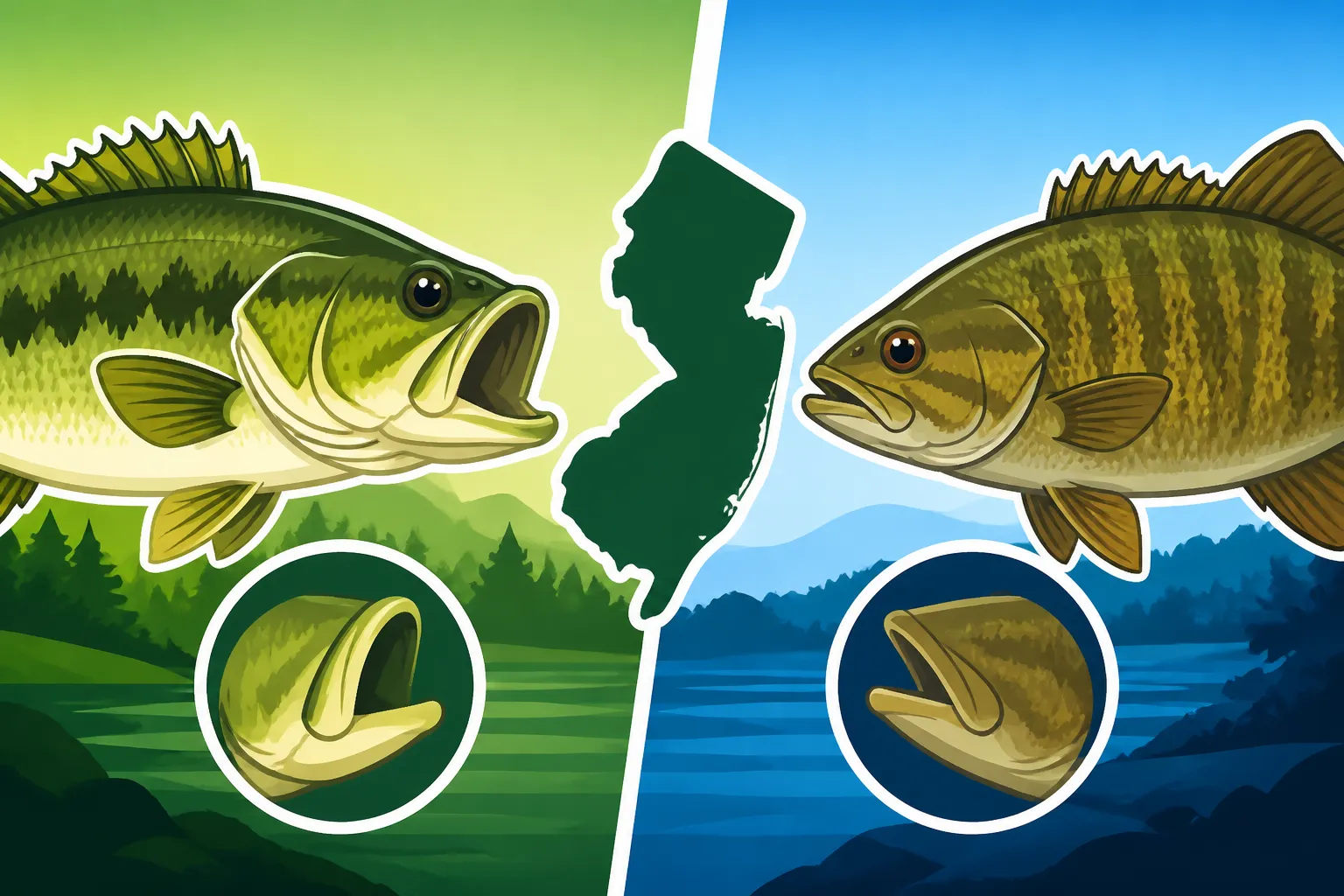
With a largemouth bass, if you hold its mouth closed and look at the corner of its jaw, you'll notice it extends significantly past the back of its eye. It's almost as if the jaw is disproportionately large for its head, creating that iconic "bucketmouth" look. Imagine trying to fit a golf ball into a largemouth's jaw; it often looks like it could manage it with ease. This extended jaw allows them to engulf larger prey, a defining characteristic of their feeding habits.
On the flip side, a smallmouth bass has a much more modest jawline. When its mouth is closed, the corner of its jaw typically aligns with the middle of its eye, or at most, only slightly beyond the back edge. It's a more proportionate, streamlined head profile. If you compare the two side-by-side, the difference becomes incredibly stark. This smaller mouth still allows them to eat a wide variety of prey, but they tend to favor slightly smaller forage compared to their largemouth cousins.
The Dorsal Fin Separation
Another excellent visual cue lies in the fish's dorsal fin, the prominent fin along its back. Both largemouth and smallmouth bass have two dorsal fins, but how they are connected (or not connected) is a dead giveaway.
For a largemouth bass, you'll see a very obvious and deep notch or separation between the spiny front portion of the dorsal fin and the soft-rayed rear portion. It looks almost like two completely distinct fins, albeit very close together. Run your finger along it (carefully, as the spines are sharp!), and you'll feel that distinct break. This pronounced division gives the largemouth's dorsal fin a somewhat jagged appearance.
A smallmouth bass, in contrast, has dorsal fins that are connected. While there's still a slight dip between the spiny and soft-rayed parts, it's a much shallower, more continuous curve. It feels almost like one long fin, just with a subtle indent. There's no deep, pronounced separation. This smoother transition often gives the smallmouth a sleeker, more torpedo-like profile when viewed from the side, which aligns with their preference for current.
Body Coloration and Markings
While coloration can vary wildly based on water clarity, diet, and even the fish's mood, there are some general patterns that can help you differentiate between the two bass species. Think of it as a general rule, but always confirm with the jaw and fin characteristics.
Largemouth bass are typically a mottled green color, often ranging from olive to almost blackish-green on their backs, fading to a lighter green or white belly. Their most distinctive marking is a dark, often irregular, horizontal stripe or series of blotches running along their lateral line from the gill plate to the tail. This stripe can be very prominent in some fish, almost like a broken racing stripe, and less defined in others. The pattern tends to be more splotchy or marbled rather than uniform.
Smallmouth bass, true to their "bronze back" nickname, usually exhibit shades of brown, bronze, or golden-olive on their backs and sides, often with a white or yellowish belly. Instead of a single horizontal stripe, they tend to have several distinct, dark vertical bars or blotches along their sides. These bars can be quite vivid in clear water, almost like tiger stripes. Their eyes are also often reddish, which is a subtle but recognizable trait. If you're fishing a clear, rocky river like sections of the Delaware River, the smallmouth's bronze hue and vertical bars really stand out against the lighter bottom.
Scales and Lateral Line
While less distinct than the mouth or dorsal fin, the lateral line and scale patterns can offer supporting evidence for identification. The lateral line is that sensory organ running down the side of the fish, often appearing as a thin, perforated line of scales.
In largemouth bass, this lateral line is usually very pronounced and continuous, often emphasizing the dark horizontal stripe mentioned earlier. The scales above and below the lateral line tend to be of a consistent size, and the overall body shape is generally more elongated and robust.
Smallmouth bass often have a less distinct lateral line, sometimes even appearing broken or faded. Their scales might appear slightly smaller and more uniform, contributing to their smoother, more muscular appearance. The vertical bars can sometimes interrupt the visual flow of the lateral line, making it less obvious. New Jersey Marine Fish Size Chart 2026 and New Jersey Freshwater Fish Size Chart 2026 can provide additional context, though specific identification relies on these physical features.
Here’s a quick comparison table to help you keep these key differences straight:
| Feature | Largemouth Bass | Smallmouth Bass |
|---|---|---|
| Upper Jaw | Extends noticeably past the back of the eye | Aligns with or only slightly past the middle of the eye |
| Dorsal Fin | Deep, distinct notch separating spiny and soft sections | Shallow, continuous curve; fins appear connected |
| Body Color | Greenish hues (olive, dark green) | Brownish, bronze, or golden-olive hues |
| Side Markings | Prominent, often irregular, dark horizontal stripe or blotches | Several distinct dark vertical bars or blotches |
| Eye Color | Typically dark | Often reddish |
| Body Shape | More elongated, somewhat chunkier | More muscular, torpedo-shaped |
Habitat and Behavior Clues: Where They Call Home
Beyond their physical appearance, largemouth and smallmouth bass have very different preferences for where they live and how they behave. Knowing these tendencies can often give you a strong hint about which species you're likely to encounter, even before you cast a line. It’s like knowing that deer prefer dense woods while rabbits might hang out in open fields – different animals, different addresses.
Largemouth Bass: The Structure Dweller
Largemouth bass are true ambush predators that thrive in warmer, often murkier, stiller waters. They love structure and cover that allows them to hide and then explode on unsuspecting prey. Think of them as the stealth operators of the bass world.
In New Jersey, you'll find largemouth bass absolutely dominating the vegetation-rich lakes, ponds, and slower sections of rivers. They'll be nestled deep in lily pad fields, tucked under fallen trees, lurking in dense weed beds, or hugging the edges of docks and submerged brush piles. Anywhere they can hide from the sun and ambush a passing baitfish, frog, or crawfish, they'll be there. Lakes like Assunpink Lake, Parvin State Park Lake, and the numerous coves and shallow sections of Lake Hopatcong are classic largemouth territories. You'll often see them caught using topwater lures or flipping jigs right into the thickest cover. For more on where to find them, check out Best Lakes for Largemouth Bass in New Jersey.
They prefer water temperatures that are generally warmer, which is why they are so prevalent in the shallower, slower-moving bodies of water. Their diet reflects their habitat: they'll eat just about anything that fits in that big mouth, from shiners and bluegill to worms, crayfish, and even small ducklings or mice. This aggressive feeding behavior in heavy cover is what makes catching a big largemouth so thrilling for many anglers. When planning your tackle, consider Best Lures for Largemouth Bass in Summer Heat to optimize your chances.
Smallmouth Bass: The Current and Rock Lover
Smallmouth bass, on the other hand, are built for speed and power in moving water. They prefer cooler, clearer, oxygen-rich waters with rocky bottoms and current. Think of them as the river gladiators.
In New Jersey, the prime smallmouth bass habitat is definitely the Delaware River, especially its upper and middle stretches, where there's plenty of current, riffles, and rocky structures. You'll also find them in deeper, clearer reservoirs and lakes with rocky shorelines and significant drop-offs, like Round Valley Reservoir or parts of Merrill Creek Reservoir. These fish love to hide behind boulders, scour the edges of swift currents for passing insects and crayfish, and patrol gravel flats. They are often less reliant on dense vegetation for cover, preferring the natural protection offered by rocks and depth. To learn more about fishing for them in specific areas, consider reading New Jersey Smallmouth Bass on the Delaware River or Round Valley Reservoir Smallmouth Bass Fishing.
Their diet consists primarily of crayfish, minnows, insects, and darters – anything that lives among the rocks and gravel. They are known for their incredibly hard fighting ability, making blistering runs and acrobatic jumps when hooked, which is why many anglers specifically target them. Their preference for cooler, cleaner water means you'll often find them in different parts of a watershed than their largemouth cousins. If you're fishing a river, you might need to adjust your approach; How to Fish New Jersey's Tidal Rivers might offer some useful insights, though smallmouth prefer less tidal, faster moving sections.
Size and Fighting Style: Beyond Just Looks
While physical traits and habitat are the primary identifiers, understanding the general size expectations and fighting characteristics of each species can also help confirm your identification, and just generally enhance your fishing experience.
Largemouth Bass: The Bulk and the Blitz
Generally speaking, largemouth bass grow larger than smallmouth bass in terms of overall length and weight. New Jersey's record largemouth is significantly heavier than the state record smallmouth, which really illustrates their potential for bulk. When you hook into a big largemouth, especially in heavy cover, be prepared for a powerful, head-shaking fight. They'll often try to dive into the nearest weeds or submerged timber, using their broad, flat bodies to create resistance. Their fight is characterized by strong, short bursts and a determination to get back into cover.
Catching a truly massive largemouth is a significant achievement for any angler, and you can delve into the details of the biggest ones caught in the state by reading New Jersey Largemouth Bass State Record. While every fish is different, the general rule is: if it feels like you're trying to pull a dinner plate out of a salad bowl, it's probably a largemouth trying to bury itself in the vegetation. Remember to follow Catch and Release Rules in New Jersey to ensure these powerful fish can continue to thrive.
Smallmouth Bass: Pound-for-Pound Powerhouses
Despite their name and typically smaller maximum size, smallmouth bass are renowned for their incredible fighting spirit. Many anglers consider them pound-for-pound the strongest fighting freshwater fish. When a smallmouth hits your lure, you'll often feel a sharp, jarring strike, followed by a series of blistering runs, aggressive head shakes, and often acrobatic jumps out of the water. They don't typically try to bury themselves in cover like largemouth; instead, they use the current to their advantage and simply fight with pure tenacity.
A 3-pound smallmouth can feel like a 5-pound largemouth, such is their spirited resistance. If you're feeling explosive energy and aerial displays, you've likely got a smallmouth on the line. They are often targeted by anglers who prioritize the thrill of the fight over sheer size, though a big smallmouth is certainly an impressive catch. Outfitting yourself with the right gear, perhaps some options found on Amazon, can make all the difference in handling these spirited fighters.
Why Does Accurate Identification Matter for Anglers?
Beyond satisfying your curiosity, knowing the difference between a largemouth and a smallmouth bass is incredibly important for several practical reasons. It impacts everything from obeying the law to improving your success on the water.
Regulatory Compliance and Conservation
New Jersey, like many states, has specific fishing regulations that can vary by species. This might include different size limits, bag limits, or even seasonal closures for largemouth versus smallmouth bass in certain waters. Misidentifying a fish could lead to inadvertently violating these rules, which nobody wants. For instance, if you're fishing in a lake with a specific slot limit for largemouth, you need to be absolutely sure you're not keeping a smallmouth that might have a different regulation.
Accurate identification also plays a critical role in conservation efforts. When anglers correctly report their catches (for example, in creel surveys or online fishing logs), it provides valuable data to fisheries biologists about the health and population dynamics of each individual species. This information helps manage fish stocks sustainably for future generations. Knowing the difference ensures we're all doing our part to protect New Jersey's incredible fishing resources. Always consult the official New Jersey Fish and Wildlife Digest for the most current rules; understanding New Jersey Freshwater Fishing Regulations Every Angler Should Know is paramount.
Tailoring Your Tactics and Gear
Understanding which bass species you're targeting allows you to significantly refine your fishing approach. If you know you're in prime largemouth territory, you'll likely opt for heavier line, weedless lures, and tactics that focus on pitching and flipping into dense cover. You might throw a frog over lily pads or a jig into thick brush. A diverse selection of tackle can be found on Amazon to cater to these specialized techniques.
Conversely, if you're in clear, rocky smallmouth habitat, you might choose lighter lines, finesse baits like drop shots or tubes, and techniques that focus on covering open water, retrieving through current, or bumping lures along the bottom. You wouldn't typically throw a bulky frog lure in the middle of the Delaware River for smallmouth. Your choice of rod, reel, line, and lure will all be influenced by the target species. Best New Jersey Fishing Gear for Beginners offers a great starting point, but specializing for bass species helps immensely. Knowing the specific behavior, like how many rods you can use at once, as covered in How Many Fishing Rods Can You Use at Once in New Jersey?, can also fine-tune your approach.
Enhanced Angling Experience
Let's face it, knowing what you've caught adds to the satisfaction of fishing. When you can confidently say, "I just landed a beautiful New Jersey smallmouth," it makes the experience richer. It allows you to appreciate the unique characteristics and fighting styles of each species more fully. It helps you understand why one fish fights differently than another, and why certain techniques yield better results in different environments.
This knowledge also empowers you to scout new waters more effectively. By looking at a map or visiting a new location, you can assess the habitat – is it weedy and shallow, or rocky and current-filled? – and make an educated guess about which bass species predominates, allowing you to prepare accordingly. A good pair of polarized sunglasses, easily found on Amazon, can help you peer into those waters and assess the habitat even better before you make your first cast.
Final Thoughts on Bass Identification
The journey of becoming a confident angler in New Jersey involves learning more than just casting a line; it means understanding the incredible diversity of fish that call our waters home. While largemouth and smallmouth bass might seem similar at first glance, a closer look reveals distinct differences in their appearance, preferred habitats, and fighting styles.
Remember to focus on those key identifiers: the mouth's extension past the eye, the separation of the dorsal fin, and the general patterns of their coloration. With a little practice, you'll be able to tell these two fantastic game fish apart in an instant. This knowledge won't just keep you compliant with regulations; it will make you a more effective and appreciative angler, helping you connect deeper with the rich fishing experiences New Jersey has to offer. So next time you hook into a bass, take a moment to observe its features, and you'll know exactly which incredible species you've been lucky enough to tangle with!
Disclaimer
This article is for general informational purposes only and does not constitute professional advice. Laws, prices and regulations vary by location and change over time. Consult a qualified professional for guidance on your specific situation.